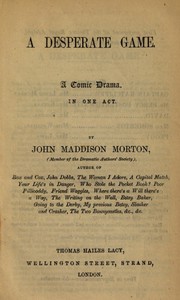
A Desperate Game: A Comic Drama in One Act — Edition Insights
Edition facts
Calculated from edition completeness, EPUB availability, text structure and catalogue metadata. Not a user rating.
The play opens in darkness, with a loud bell ring and a stranger, Captain Ratcliffe, barging into Mrs. Somerton's drawing room at four in the morning. He is closely followed by David, a servant carrying a lantern, who immediately questions the captain's identity and purpose. Ratcliffe's first line, 'Now then, my good friend, a little quicker, if you please,' establishes his impatient, commanding tone. The stage directions note that Ratcliffe 'throws a hasty look round the room' and mutters 'so far, so well,' revealing his covert objective. David's aside—'this be about the free and easiest chap I ever cut in with'—underscores the intrusion's audacity. The scene sets up a tension between Ratcliffe's calculated entrance and David's suspicious, comic interrogation.
A Single Room, a Clock, and a Writing Desk
The entire drama unfolds in Mrs. Somerton's drawing room, a space meticulously described in the opening stage directions: a fireplace with bell ropes, two doors, a small window, a clock on the mantelpiece, and a work table with a writing desk. This confined setting heightens the sense of entrapment and surveillance. The clock is mentioned early, marking the odd hour of four in the morning, and later Ratcliffe uses the writing desk as a prop to confirm the theft of bank notes. The room becomes a stage for Ratcliffe's performance as a detective, while Mrs. Somerton's fixed gaze on him suggests she recognizes more than she admits. The physical objects—the bell, the desk, the clock—are not mere decoration but tools that advance the plot and reveal character intentions.
Voices and Glances: The Unspoken Recognition
A recurring pattern in the excerpts is the emphasis on voice and visual recognition. Mrs. Somerton repeatedly notes Ratcliffe's voice: 'That voice again—I must be mistaken—yet, every word he utters.' She also gives a 'very slight start' when first seeing him, and later looks at him 'with intention' while speaking of a clue. Ratcliffe, in turn, maintains 'the utmost sang froid,' but his aside 'I must get rid of this fellow' reveals his unease. The dialogue is layered with asides and stage directions that signal unspoken knowledge. For instance, when Mrs. Somerton says she might 'compromise' someone, Ratcliffe interrupts with legal bluster. The play uses these glances and vocal cues to build suspense, suggesting that the characters share a history not yet disclosed to the audience.
Comic Misalignment: The Cousin's Interruptions
Mr. Percy Postlethwaite, the cousin, functions as a source of comic friction. He repeatedly interrupts Ratcliffe's questioning with asides that undercut the detective's authority. When Ratcliffe mentions Mrs. Somerton's 'piercing shrieks,' Postlethwaite pulls his coat tail and whispers 'That'll do—don't remind her of that terrific scene.' Later, when Ratcliffe refers to 'the length of time you were struggling with him,' Postlethwaite again interjects 'That'll do—she can't bear it.' These interruptions create a rhythm of misinformation: Postlethwaite claims there were multiple robbers, while Mrs. Somerton insists on only one. His eagerness to 'mince him' contrasts with his actual cowardice, and his aside about the 'fifteen thousand pounds' reveals his mercenary concern. This misalignment between characters' statements and their private asides drives the comedy and the plot's uncertainty.
Readers should attend to the stage directions and asides, which carry much of the play's subtext. The single-act structure means every line and gesture is compressed; the bell ropes, the clock, and the writing desk are not incidental. Morton's comedy relies on what is half-said and half-seen—a glance, a start, a voice half-remembered. The play rewards careful attention to these details, as they hint at a backstory the characters themselves are reluctant to voice.
Elijah Flores
3 weeks agoJack Anderson
2 weeks ago-
Margaret Padilla - 2 weeks ago
{'review_type': 'positive', 'text': 'A brilliant comic drama that keeps you on the edge of your seat with its clever plot and fast-paced action. The dialogue is sharp, and the situations are both hilarious and tense. The characters are engaging, and the resolution is satisfying. A must-read for fans of comedy and drama alike.'} -
Judy Lisa Barrera - 2 weeks ago
{'review_type': 'critical', 'text': 'Despite its promising title, this comic drama falls flat. The plot is convoluted and predictable, and the humor feels strained. The characters are stereotypes, and the dialogue is often forced. It could be a decent stage romp, but as a written work, it lacks the sharpness and originality needed to stand out.'} -
Autumn Joshua Mcdonald - 1 week ago
{'review_type': 'neutral', 'text': "An enjoyable one-act play with a fun premise and some witty exchanges. The pacing works well for the format, and it holds attention. However, the ending feels rushed and the character motivations are a bit thin. It's a light, entertaining read but not particularly deep."}
How did this book work for you?
Your answers remain private and are stored only in this browser.
Isabella Martinez
1 week ago