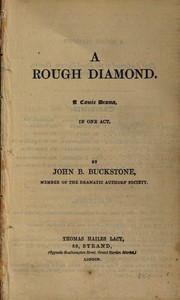
A Rough Diamond: A Comic Drama in One Act — Reading Notes

(4 User reviews)   514
Buckstone, John Baldwin, 1802-1879 Project Gutenberg 2014
Comedy plays; English drama -- 19th century Readers of public-domain and historical texts
Project Gutenberg digital edition en

Edition facts

Words: 12,259
Reading time: 54 min
Text sections: 2
A one-act comic drama by John Baldwin Buckstone, first performed in 1847, centering on Margery, a country woman married to Sir William Evergreen, who rebels against her constrained life. The play contrasts rural simplicity with aristocratic formality, using rapid-fire dialogue and physical comedy to explore identity and class.
Share
Editorial Edition Score 4.5/5

Calculated from edition completeness, EPUB availability, text structure and catalogue metadata. Not a user rating.

Edition quality

The play opens with a stage direction specifying a country residence, statues, and flower stands, immediately establishing a setting of cultivated gentility. Yet the first line of dialogue—Sir William Evergreen’s hearty “Come in, come in—I’m delighted to see you”—introduces a tone of bluff sociability that soon collides with the rigid decorum of Lord Plato and the earthy directness of Cousin Joe. Buckstone’s stagecraft relies on sharp contrasts: the formal garden versus the rustic memories of cherry-tree climbing and market carts, the polished boots of Lord Plato versus the hob-nailed shoes of Joe. The drama’s comic engine is the friction between Margery’s remembered freedom and her present confinement, a tension made visible in the costume list, where Margery’s first dress is a “large straw hat, apron, garden gloves” and her second is a “Lancashire cotton jacket; coarse petticoat, wooden clogs.”

Costume as Character

Buckstone’s detailed costume descriptions do more than guide a production; they encode the play’s central conflict. Margery’s two dresses—first a “low satin dress” beneath a straw hat and apron, then a “coarse petticoat” with wooden clogs—map her oscillation between the roles of lady and country girl. When she declares, “I will go and put on my old country clothes again,” she is not merely changing fabric but reclaiming an identity. Similarly, Cousin Joe’s “showy plush waistcoat, corded trousers, hob-nailed and laced boots” visually announces his class and his refusal to adapt to the drawing-room. Lord Plato’s “polished boots” and Sir William’s “frock coat” stand as emblems of the world Margery finds suffocating. The play’s comedy often springs from these visual clashes: Joe, seated and hat on, stares at the aristocrats while Margery insists, “I will be myself again.”

The Rhythm of Repetition

A distinctive structural feature of the dialogue is the echo. When Margery says, “we couldn’t help it,” Joe immediately repeats, “No, we couldn’t help it.” When Sir William scolds, “your conduct, Madam, is most unbecoming,” Joe parrots, “You take good care that she sha’n’t.” This device does more than generate laughs; it creates a duet of defiance, with Joe acting as Margery’s vocal double. The pattern reaches its peak in the rapid-fire exchange of village gossip, where Joe reels off a breathless list of local changes—“the dog’s gone to live with a baker,” “Jem’s in prison for debt,” “they’ve pulled down the old parsonage”—and Margery responds, “Oh, Joe! I can shut my eyes and see everything.” The accumulation of detail builds a shared world that the aristocratic characters cannot enter. Repetition here becomes a form of solidarity, a verbal clasping of hands against the alienating demands of station.

The Geography of Memory

Margery and Joe’s reunion is a tour of a vanished landscape. They recall climbing the cherry-tree, sitting “at the bottom of the cart and eat apples,” and the “knocks on my nose” that followed Joe’s attempted kisses. These memories are tactile and specific—hob-nail shoes, wooden clogs, the feel of a cherry branch—and they stand in pointed contrast to the stage’s statues and flower stands. The play’s setting is a country residence, but the real geography is the remembered village: the baker’s shop, the blacksmith’s forge, the parsonage being rebuilt. When Margery says, “I can shut my eyes and see everything and everybody you’ve been talking about,” she is asserting that her true home is not the house she lives in but the one she carries in her mind. Buckstone uses this tension between visible stage and invisible memory to dramatize a woman caught between two worlds, neither of which fully contains her.

Readers approaching A Rough Diamond should attend to its physical comedy and rapid exchanges, which carry the weight of its social critique. The play rewards attention to its stage directions, costume notes, and the rhythm of repeated phrases. Buckstone’s Advertisement, mourning the actress Mrs. Fitzwilliam, hints that the role of Margery was shaped by a specific performer’s warmth; the text invites us to imagine how that warmth might animate the rebellion against “head, and arms, and legs were all put on the wrong way.”

Lucas Jackson
1 week ago

Anthony Walker
1 month ago

Grayson White
1 week ago

Sofia Brown
4 weeks ago

4.5
4.5 out of 5 (4 User reviews )

Add a Review

Your Rating *
There are no comments for this eBook.

Reader reflection

Your personal reading reflection

Build a private reading journal entry for this title.

Your progress 0 / 10
1

How far have you progressed with this book?

2

Was reading this book enjoyable?

3

Is this a title you would suggest to others?

4

Did the language feel accessible?

Related eBooks