1

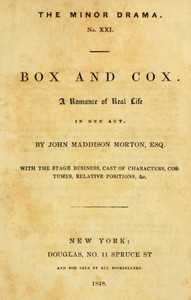
Box and Cox: A Romance of Real Life in One Act. — Inside the Classic
(0 User reviews)
307
Project Gutenberg
2013
Not confirmed
Comedy plays; English drama -- 19th century
Readers of public-domain and historical texts
Project Gutenberg digital edition
en
Edition facts
Words
10,517
Reading time
46 min
Text sections
2
Box and Cox: A Romance of Real Life in One Act. — Inside the Classic can be approached with a clearer sense of reading commitment from its source measurements: 10,517 words, 46 min estimated reading time, and 2 detected text sections.
The text analysis averages about 12.2 words per sentence, while the detected sections provide another way to judge how the source is divided.
Project Gutenberg metadata also associates the work with “Comedy plays,” connecting these edition facts with the source record’s subject description.
Source:
Project Gutenberg record #42523
A one-act farce where two men unknowingly rent the same room at different hours, leading to escalating comic confrontations over a shared bed, a suspicious landlady, and an unexpected proposal.
Read the complete public-domain text at its original source.
Read on Project GutenbergThe play opens with Cox, a journeyman hatter, complaining about his haircut and the flatness of his bolster—details that immediately establish his fussy, theatrical personality. The stage directions specify a bed with closed curtains at center, a room decently furnished, and multiple doors, hinting at the farcical entrances and exits to come. Mrs. Bouncer, the landlady, enters and the dialogue quickly reveals that Cox rents the room only during the day, while Box, a printer, occupies it at night. This arrangement, kept secret from both tenants, is the engine of the comedy.
A Room Divided by Time
The central conceit—two men sharing a single room without knowing it—is established through careful stage business. Mrs. Bouncer’s evasions and the characters’ obliviousness create a pattern of near-misses. Cox’s morning departure and Box’s evening arrival are never shown, but the audience infers the routine from the landlady’s nervousness and the men’s references to their schedules. The bed, with its closed curtains, becomes a silent witness to the deception. When Cox complains about the bolster, he unknowingly describes the very object Box will later grumble about. This shared dissatisfaction with the same bed linens is a subtle, recurring joke that builds across the excerpts.
The Dice and the Double-Headed Shilling
The middle excerpt features a escalating argument over a woman named Penelope Ann. Both men claim to despise her, yet each refuses to let the other have her. Their solution—drawing lots, then dice, then coin tosses—spirals into absurdity as they repeatedly throw sixes and heads. The humor derives from their mutual suspicion and the revelation that each possesses loaded dice: Box’s dice always throw sixes, and Cox’s sixpence has no tail. The stage direction “they each turn aside and take out a handful of money” underscores their secretive, competitive nature. The scene culminates in a physical confrontation, interrupted by Mrs. Bouncer’s entrance, leaving the dispute unresolved.
Sparring and Shared Space
The physical comedy intensifies as Box and Cox square off, retreating to opposite sides of the stage before “sparring and striking fiercely at one another.” The stage directions emphasize their symmetrical movements, mirroring the symmetry of their situation. Mrs. Bouncer’s return with news that the “little back second floor room” is not ready, and that she cannot find the pistols, suggests a planned duel that never materializes. This anticlimax is typical of farce: the threat of violence is deflated by practical obstacles. The men’s shared lodging, once revealed, forces them into an uneasy truce, but the excerpts end before any resolution, leaving the reader to wonder how the romance of real life will unfold.
Costume and Character Cues
The detailed costume descriptions in the cast list offer clues to each character’s social standing and personality. Box wears a “small swallow-tailed black coat” and “white canvass boots with black tips,” suggesting a shabby-genteel printer. Cox’s “brown Newmarket coat” and “white hat” mark him as a more fashionable, perhaps pretentious, hatter. These visual contrasts reinforce the verbal sparring. The stage directions also specify the room’s layout: a window at back right, a fireplace at right, and multiple doors. This configuration allows for rapid entrances and exits, a staple of one-act farce. Readers should note how the physical space—the bed, the table, the dice—becomes a character in itself, shaping the comedy.
Readers approaching this farce for the first time should pay attention to the rhythm of entrances and exits, as the comedy depends on timing and misdirection. The dialogue is brisk, with characters often speaking in parallel or finishing each other’s thoughts. The play’s subtitle, “A Romance of Real Life,” is ironic: the romance is a forced marriage plot, and the real life is a cramped lodging. Enjoy the verbal and physical gags, and note how the playwright uses repetition—of complaints, of dice throws, of coin tosses—to build comic tension.
That rainy afternoon, I kept turning over the odd tenderness beneath Box and Cox's slapstick—two strangers sharing a life they never meant to. Later, almost by accident, my hand found Beggars Bush: A Comedy From the Works of Francis Beaumont and John Fletcher (Volume 2 of 10) — Text and Context, and the same quiet thought followed me: how disguise and mistaken identity sometimes reveal more truth than plain speech ever could.
There are no reviews for this eBook.
There are no comments for this eBook.
Reader reflection
What did you think of this book?
Answer a few questions and save a private reflection on this device.
Your progress
0
/
10
2
How much did you enjoy the reading experience?
3
Would you encourage someone else to read it?
4
Did the language feel accessible?
5
How clearly were the main ideas presented?
6
How valuable was this book for your own interests?
7
How personally connected did you feel to the book?
8
Which aspect of the book did you value most?
9
In one sentence, what did you learn?
10