1

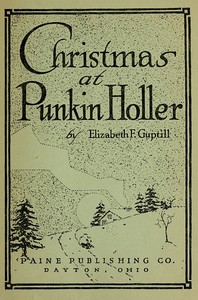
Christmas at Punkin Holler — Reading Notes
(0 User reviews)
2289
Project Gutenberg
2016
Not confirmed
Drama; Christmas plays
Readers of public-domain and historical texts
Project Gutenberg digital edition
en
Edition facts
Words
11,306
Reading time
50 min
Text sections
2
Before opening Christmas at Punkin Holler — Reading Notes, the edition data offers a quick orientation: 11,306 words, 50 min estimated reading time, and 2 detected text sections.
The text analysis averages about 12.5 words per sentence, while the detected sections provide another way to judge how the source is divided.
Project Gutenberg metadata also associates the work with “Drama,” connecting these edition facts with the source record’s subject description.
Source:
Project Gutenberg record #53831
A Christmas play set in rural Punkin Holler, blending dialect-heavy dialogue, musical numbers, and detailed stage directions. The catalog subjects 'Drama' and 'Christmas plays' fit, but the work is more a community entertainment script than a literary drama, with songs and motion cues for amateur performers.
Read the complete public-domain text at its original source.
Read on Project GutenbergChristmas at Punkin Holler is a play script built around a series of songs, recitations, and comedic set pieces, all framed by the preparations for a Christmas tree ceremony. The catalog subjects list it as 'Drama' and 'Christmas plays,' but the excerpts reveal a work that functions less as a narrative drama and more as a template for a community variety show. The dialogue is thick with rural dialect—'warn’t it a nice one,' 'the peskiest thing'—and the action is punctuated by detailed motion instructions for performers, such as 'hit nose with forefinger, with downward stroke.' The play includes an 'orchestra' of homemade instruments: drum, bones, jewsharp, triangle, and paper-covered combs. This is not a play meant for silent reading; it is a performance kit for a school or church group.
Dialect and Local Color as Structural Devices
The script relies heavily on phonetic spelling to establish a rural, folksy setting. Characters say 'ma' for mother, 'thutty' for thirty, and 'orchestry' for orchestra. This is not merely decorative; the dialect is the primary means of characterization. Aunt Hepsey, for instance, is defined by her folksy commentary: 'Wal, wal! So that’s an orchestry!' The play’s humor often comes from the contrast between the characters’ unsophisticated speech and the formal expectations of a Christmas program. The teacher, Miss P., speaks standard English, creating a clear social dynamic. The dialect also serves a practical purpose: it makes the lines easier for amateur actors to deliver naturally, as the spelling cues the pronunciation.
Music and Motion as Core Elements
The play includes multiple songs with specified tunes—'Lightly Row,' 'While Shepherds Watched,' 'Glory Hallelujah'—and each song is accompanied by precise stage motions. For example, the Christmas Fairy’s song includes instructions like 'wand high, to right, bring down, obliquely' and 'trip lightly to one side.' These motion cues are as important as the dialogue; they turn the performance into a choreographed spectacle. The 'orchestra' scene, where children play on combs and drums, is a comic highlight that relies on timing and audience recognition of the tune. The play also advertises sheet music for songs like 'Jolly Pickaninnies' and 'Lullaby Lane,' indicating that the script was part of a larger commercial ecosystem of performance materials.
The Play as a Commercial Product
The excerpts include promotional pages for songs by Edna Randolph Worrell, such as 'We Hope You’ve Brought Your Smiles Along' and 'Jolly Pickaninnies.' These are not part of the play itself but are bundled with it, suggesting that the book was marketed as a package for school entertainments. The play’s structure—short scenes, flexible casting, simple props—reflects a design for easy production by groups with limited resources. The catalog subject 'Drama' is accurate, but the work is more akin to a manual for a Christmas pageant than a literary drama. The inclusion of songs with racial stereotypes ('Jolly Pickaninnies') also reflects the period’s commercial entertainment norms, which modern readers should note critically.
Readers approaching this text should treat it as a historical artifact of early 20th-century community theater. The play’s value lies not in plot or character development but in its reflection of rural performance practices, dialect representation, and the commercial apparatus of school entertainments. The catalog subjects are correct but incomplete; the work is best understood as a script for a participatory event, not a standalone literary work. Pay attention to the stage directions and song lyrics, which carry as much weight as the spoken lines.
That afternoon in Punkin Holler, the amateur cast’s clomping stage directions made me smile—community warmth disguised as chaos. Later, flipping through my notes, I thought of Freezing a Mother-in-Law; or, Suspended Animation: A farce in one act — Background and Themes, where comedy also leans on frozen embraces and family mischief. Both scripts feel less like polished drama, more like a porch light left on after everyone’s gone home.
There are no reviews for this eBook.
There are no comments for this eBook.
Reader reflection
What did you think of this book?
Answer a few questions and save a private reflection on this device.
Your progress
0
/
10
2
What was your overall reaction to the book?
3
How likely are you to recommend this book?
4
Did the language feel accessible?
5
Could you apply anything you learned?
6
How closely did the book connect with your experience?
7
What did you appreciate most?
8
Did the book offer a fresh perspective?
9
What is the main idea you are taking away?
10