1

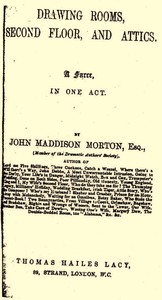
Drawing Rooms, Second Floor, and Attics: A Farce, in One Act — Text and Context
(0 User reviews)
236
Project Gutenberg
2015
Not confirmed
Comedy plays; English drama -- 19th century
Readers of public-domain and historical texts
Project Gutenberg digital edition
en
Edition facts
Words
13,417
Reading time
59 min
Text sections
4
The source record for Drawing Rooms, Second Floor, and Attics: A Farce, in One Act — Text and Context measures this digital text at 13,417 words, 59 min estimated reading time, and 4 detected text sections.
The text analysis averages about 15.3 words per sentence, while the detected sections provide another way to judge how the source is divided.
Project Gutenberg metadata also associates the work with “Comedy plays,” connecting these edition facts with the source record’s subject description.
Source:
Project Gutenberg record #49665
Morton's 1864 farce uses a single set of three vertically stacked rooms—attic, second floor, drawing rooms—to generate comic collisions between servants, tradesmen, and gentry. The play's rapid door-slamming, mistaken identities, and physical business (a clothesline, a loaded tray, a bolted shutter) rely on precise stagecraft and class-inflected dialogue.
Read the complete public-domain text at its original source.
Read on Project GutenbergJohn Maddison Morton’s 1864 farce Drawing Rooms, Second Floor, and Attics opens not in a drawing room but in an attic, where Phœbe sings while taking down a clothesline. The stage direction specifies a “slanting roof” and “two large chimney pots,” immediately establishing a vertical axis that the play will exploit: the attic belongs to servants, the second floor to lodgers, and the drawing rooms to the host, Mr. Bunny. Morton’s title is a literal floor plan, and the action moves through these spaces in four scenes, each shift announced by a “scene draws and discovers” cue. The farce’s engine is the tension between what happens in each zone—Phœbe’s private anxiety about Triptolemus, Jonathan’s pilfering of negus, Bunny’s frantic hosting—and the characters’ attempts to keep those spheres separate.
Vertical Stagecraft and Social Geography
The play’s structure is architectural. Scene I is set in an attic with a small door and window; Scene II takes place in a “Second Floor” apartment; Scene III returns to the second floor; Scene IV opens onto the drawing rooms with folding doors, a corridor, and a ballroom beyond. Each change of scene is a change of social altitude. The attic is Phœbe’s domain, where she sings and works; the second floor belongs to Captain Hardaport and Arabella; the drawing rooms are Bunny’s public stage. Morton uses doors and windows as comic valves: Phœbe’s window looks out for Triptolemus, Bunny bolts the shutters against rain, and a “small door” leads to a back staircase—a servant’s shortcut that collapses distance between floors. The farce’s pace depends on characters entering and exiting through these precisely plotted apertures, often at cross-purposes.
Props as Personality: Clothesline, Tray, and Wig
Morton loads his stage with objects that define character and drive action. Phœbe’s clothesline is both a practical task and a visual marker of her attic workspace. Jonathan’s loaded tray becomes a site of temptation: he eats a cake and drinks a glass of negus before Bunny corrects his posture (“Present the tray at the end of a poker”). Bunny himself appears in a “light flaxen wig,” a comic sign of vanity or disguise. The table in Scene IV is “covered with pastry, cakes, decanters, wine glasses”—a feast that promises chaos. Even the weather intrudes: rain is heard, and Bunny closes the shutters, trapping characters inside. These props are not decorative; they are mechanisms for mishap. A tray improperly presented, a wig askew, a bolted window—each creates a beat of physical comedy that the dialogue then amplifies.
Dialogue as Misdirection and Repetition
Morton’s characters speak in overlapping registers. Phœbe’s folk-song (“I’m off to Charlestown”) contrasts with Bunny’s fussy commands (“the cakes are totally incapable of handing themselves about”). Jonathan’s malapropism—“Present the tray at the end of a poker”—shows a servant mishearing “polka” as a physical threat. The dialogue often works by repetition: Bunny’s “What the devil are you at?” echoes his earlier “What’s that?” as he peers at Jonathan. Characters speak in asides, revealing private fears (“Oh, dear! oh, dear! he’ll be drownded!”) while maintaining public composure. This layering of spoken and unspoken creates the farce’s central tension: everyone is trying to manage a performance, and the script gives them just enough rope to trip over.
Readers should attend to the stage directions as closely as the dialogue. Morton specifies not only where characters stand but how they move—a “graceful attitude” for presenting a tray, a “slightly tipsy” entrance with a red comforter. The farce’s humor lives in these physical details, which the text preserves with unusual precision. Treat the play as a blueprint for performance: every door slam, every misplaced cake, every bolted shutter is a cue for laughter.
There’s something oddly tender about Morton’s stacked rooms—everyone colliding yet never quite seeing each other, like old neighbors sharing a wall. I found myself thinking of that loneliness while rereading The Parlor Car’s quieter moments, where movement promises connection but mostly delivers proximity. That same wistful ache lingers there, a soft echo of shutters banging in the dark. The Parlor Car — Key Ideas to Explore stays with me like a half-remembered train whistle.
There are no reviews for this eBook.
There are no comments for this eBook.
Reader reflection
Your personal reading reflection
Build a private reading journal entry for this title.
Your progress
0
/
10
2
Was reading this book enjoyable?
3
How likely are you to recommend this book?
4
How demanding did the text feel?
5
Did this book create an emotional response?
6
Would this book work well in a reading group?
7
How well did it match your expectations?
8
What was the strongest part of the book?
9
Which lesson or insight stayed with you?
10