1

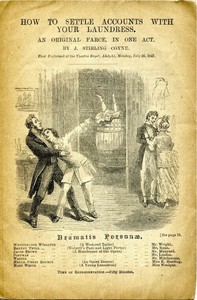
How to Settle Accounts with your Laundress: An Original Farce, in One Act — Edition Insights
(0 User reviews)
699
Project Gutenberg
2015
Not confirmed
Comedy plays; English drama -- 19th century
Readers of public-domain and historical texts
Project Gutenberg digital edition
en
Edition facts
Words
10,942
Reading time
48 min
Text sections
4
For How to Settle Accounts with your Laundress: An Original Farce, in One Act — Edition Insights, the stored edition analysis reports 10,942 words, 48 min estimated reading time, and 4 detected text sections.
The text analysis averages about 12.1 words per sentence, while the detected sections provide another way to judge how the source is divided.
Project Gutenberg metadata also associates the work with “Comedy plays,” connecting these edition facts with the source record’s subject description.
Source:
Project Gutenberg record #49728
Coyne's 1847 one-act farce uses mistaken identity, cross-dressing, and a tailor's showroom to comic effect. The opening stage directions and dialogue establish a fast-paced, physical comedy where characters adopt disguises and the plot hinges on a laundress's unpaid bill.
Read the complete public-domain text at its original source.
Read on Project GutenbergThe play opens with a detailed stage direction placing the action in a tailor's showroom on Jermyn Street, furnished with a cheval glass, a dummy figure in extreme fashion, and a large round table. The first character we meet is Twill, the page, brushing a coat and singing an Irish song. The postman's knock immediately sets a brisk, comic rhythm. Coyne's stage directions specify exits and entrances with abbreviations like R., L., and C., and remind the reader that they are supposed to be on stage facing the audience—a framing that invites imaginative participation.
Disguise and Double Identity
From the outset, disguise drives the plot. Widgetts, the tailor, hides from his laundress by swapping his blue coat for an old black one and fashioning whiskers from chair stuffing. He claims the hair can “whisker a regiment of Turks.” Meanwhile, Mary White, the laundress, enters dressed as a young man, drying her hands with a towel. She tells Widgetts she is a detective police officer, and he immediately fears “the dreadful deed’s discovered.” The farce thrives on these layered deceptions: each character adopts a false identity, and the audience is in on every switch.
Physical Comedy and Stage Business
Coyne’s farce relies heavily on physical gags and prop comedy. Widgetts cuts open a chair seat to extract hair for his whiskers. Later, as a supposed waiter, he is forced to lay the table for his own supper, muttering “D—n the table” under his breath. The stage directions call for precise movements: Mary White “lays her hand on Widgetts’ shoulder, who starts,” and Widgetts “polishes a plate, furiously.” These small actions amplify the humor of his helplessness. The dummy figure and the cheval glass also serve as silent witnesses to the chaos.
Social Satire Through Character Types
The characters are recognizable comic types from Victorian theatre. Widgetts is the flustered tradesman trying to maintain respectability; Mary White is the clever servant who outwits her master; Mademoiselle Cheri Bounce is the fashionable opera dancer, described as wearing a “blue satin visite, trimmed with lace.” Coyne uses their exaggerated costumes and speech to poke fun at social pretensions. When Cheri calls Widgetts “stupid,” and Mary replies “Hang Widgetts,” the dialogue underscores the reversal of power: the laundress and the dancer now control the tailor’s fate.
Pacing and the One-Act Structure
The play is designed for a performance time of fifty minutes, and the excerpts show how Coyne packs incident into a single act. The opening scene establishes the setting and conflict within a few lines. The middle excerpt accelerates the action with a supper scene where Widgetts, disguised as a waiter, must serve his own guests. The dialogue is rapid, with short lines and frequent interruptions. Coyne’s use of asides—Widgetts’ muttered curses—keeps the audience aligned with his predicament. The one-act form demands economy, and Coyne delivers it through brisk entrances and exits.
Readers should pay attention to the stage directions, which are as much a part of the comedy as the dialogue. Coyne’s detailed descriptions of costume changes and prop use reward a careful reading. The farce’s humor depends on timing and visual gags, so imagining the physical action on stage enhances the experience. The title’s promise of “settling accounts” is fulfilled not through payment but through a series of comic reversals that leave the tailor thoroughly unsettled.
There’s something tender about these old farces, the way disguises let people fumble toward honesty. Reading How to Settle Accounts with your Laundress, I kept thinking of mismatched pairs and gentle tricks, which is exactly what lingers in Beggars Bush: A Comedy From the Works of Francis Beaumont and John Fletcher (Volume 2 of 10) — Text and Context. Both feel like letters from another century, still warm to the touch.
There are no reviews for this eBook.
There are no comments for this eBook.
Reader reflection
How did this book work for you?
Your answers remain private and are stored only in this browser.
Your progress
0
/
10
2
How did the book work for you overall?
3
Is this a title you would suggest to others?
4
How demanding did the text feel?
5
What did you think about the pace?
6
What was its emotional impact?
7
How strong was your personal connection to the text?
8
How clear did the writing feel?
9
What is the main idea you are taking away?
10