
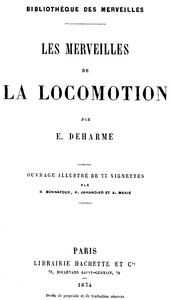
Les Merveilles de la Locomotion by E. Deharme
Let's set the scene: it's the 19th century, and the world is getting smaller. Not literally, of course, but the iron horse—the steam locomotive—is stitching continents together. Ernest Deharme's book is his attempt to capture that dizzying moment for his contemporaries. He writes with the breathless excitement of someone witnessing a revolution in real-time.
The Story
There isn't a traditional plot with characters. Instead, the 'story' is humanity's collision with the machine age. Deharme acts as a guide, walking us through the incredible mechanics of steam engines, the engineering marvels of bridges and tunnels, and the new landscapes—both physical and social—that the railways created. He describes the sheer spectacle of a train's power and the profound shift in how people experienced time and space. A journey that once took weeks could now be done in days. The book is a tour of this new, accelerated world, from the soot and steam of the locomotive to the grand, echoing stations that became the cathedrals of the industrial era.
Why You Should Read It
What makes this book special isn't the technical detail (though there's plenty for gearheads), but the human perspective. Deharme's writing is infused with a sense of awe. He sees the locomotive not just as a tool, but as a symbol of progress and human ingenuity. Reading it today is a powerful reminder of how disruptive and magical our now-ordinary technologies once were. It makes you look at your smartphone or electric car with new eyes. You get to feel the collective 'wow' of a society stepping onto a platform for the very first time, unsure of the destination but thrilled by the speed.
Final Verdict
This is a perfect little book for history buffs, tech enthusiasts, or anyone who enjoys a dose of historical perspective. It's for the reader who wonders, 'What did it feel like when this all started?' It’s not a challenging read, but a reflective one. Think of it as a beautifully written postcard from the dawn of the age of speed, reminding us that every seismic shift in technology begins with a simple, shared sense of wonder.
This text is dedicated to the public domain. You are welcome to share this with anyone.
Barbara Lee
1 year agoA must-have for anyone studying this subject.
Donald Miller
1 year agoI had low expectations initially, however the arguments are well-supported by credible references. A true masterpiece.
Joseph Clark
2 years agoI stumbled upon this title and the arguments are well-supported by credible references. A true masterpiece.
Linda Rodriguez
1 year agoGreat read!









Lisa Miller
9 months agoThe fonts used are very comfortable for long reading sessions.