1

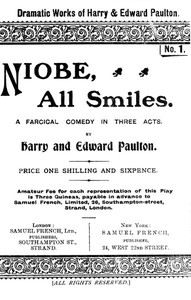
Niobe, All Smiles: A Farcical Comedy in Three Acts — A Reader’s Guide
(0 User reviews)
741
Project Gutenberg
2014
Not confirmed
Comedy plays; England -- Social life and customs -- 19th century -- Drama; Niobe (Greek mythology) -- Drama
Readers of public-domain and historical texts
Project Gutenberg digital edition
en
Edition facts
Words
27,748
Reading time
121 min
Text sections
4
Before opening Niobe, All Smiles: A Farcical Comedy in Three Acts — A Reader’s Guide, the edition data offers a quick orientation: 27,748 words, 2 hr 1 min estimated reading time, and 4 detected text sections.
The text analysis averages about 10.6 words per sentence, while the detected sections provide another way to judge how the source is divided.
Project Gutenberg metadata also associates the work with “Comedy plays,” connecting these edition facts with the source record’s subject description.
Source:
Project Gutenberg record #46226
This editorial note examines the farcical structure, recurring imagery of classical vs. modern, and movement between scenes in the three-act comedy 'Niobe, All Smiles' by Harry and Edward Paulton.
Read the complete public-domain text at its original source.
Read on Project GutenbergThe three-act structure of Niobe, All Smiles is built on a series of rapid entrances and exits, with characters frequently crossing the stage in fear of interruption or to observe the street. The stage directions—such as “crosses L., up stage in fear of interruption” and “goes up L., watching”—indicate a choreographed anxiety that propels the farce. The play’s comedy arises from the collision between Niobe’s mythological dignity and the mundane bustle of Victorian England, a contrast reinforced by the physical movement between interior and exterior spaces.
Choreographed Anxiety and Stage Movement
The stage directions in the excerpt reveal a precise choreography of nervous movement. Dunn repeatedly crosses upstage to watch for interruptions, while Niobe moves between the window and the center of the room, drawn by the spectacle of the street. The postman’s knock is heard three times, a rhythmic intrusion that punctuates the dialogue. This pattern of characters entering, exiting, and repositioning themselves creates a sense of controlled chaos, typical of farce. The physical comedy is embedded in the blocking: Dunn sits on a footstool, then rises; Niobe weeps on the table, then goes to the window. Each movement underscores the power imbalance between the two characters.
Mythological Dignity vs. Victorian Mundanity
Niobe’s dialogue consistently frames her surroundings through a classical lens. She sees “chariots” where Dunn sees “cabs” and “Growlers”; she interprets a boy on a bicycle as “the man upon the wheel” (Ixion). The postman becomes a “Herald.” This recurring image of misrecognition—where modern objects are translated into mythological terms—drives the comedy and highlights Niobe’s displacement. Dunn’s retorts deflate her grandeur: “The gods don’t amount to a row of pins.” The play’s humor depends on this clash of registers, with Niobe’s elevated language colliding with Dunn’s pragmatic, colloquial speech.
The Governess as a Role to Perform
Niobe’s instruction in how to be a governess is a meta-theatrical lesson in performance. Dunn coaches her on tone and gesture: “say ‘yes Ma’am’—always—‘Yes Ma’am,’” and demonstrates a nasal tone with a bob curtsey. Niobe imitates him “wonderingly,” revealing her unfamiliarity with servility. The scene explicitly treats social roles as acts to be learned, a theme that resonates with the play’s farcical nature. The repeated phrase “Yes Ma’am” becomes a comic refrain, and Dunn’s warning to “agree with the old cat in all things” underscores the performative demands of Victorian domestic hierarchy.
Windows, Doors, and the Outside World
The window serves as a recurring threshold between the domestic interior and the chaotic outside. Niobe repeatedly goes to the window to observe the crowd, the “strange chariots,” and the postman. Dunn, by contrast, watches the door and listens for interruptions. This spatial opposition—Niobe looking out, Dunn looking inward—mirrors their conflicting perspectives: Niobe’s curiosity about modern life versus Dunn’s anxiety about maintaining appearances. The play’s movement between scenes likely exploits these thresholds, using entrances and exits to introduce new complications and sustain the farcical pace.
Readers attentive to stage directions will notice how the Paultons use physical movement to reinforce character dynamics and comic timing. The play’s humor depends less on plot twists than on the friction between Niobe’s classical frame of reference and the prosaic realities of Victorian England. Observing how characters enter, exit, and reposition themselves offers a key to the farce’s rhythm.
Reading the editorial notes on Niobe, All Smiles again, I found myself lingering on how the farcical movement between drawing-room manners and classical folly makes time feel pleasantly suspended. That same gentle contradiction—of poised actors forever circling a quiet absurdity—reminded me of another play I once knew, where the joke never quite lands but lingers anyway, much like Green Stockings: A Comedy in Three Acts — Context and Discussion. Some evenings simply echo others.
There are no reviews for this eBook.
There are no comments for this eBook.
Reader reflection
How will you remember this book?
Save your reaction, strongest insight, and memorable passage.
Your progress
0
/
10
2
How much did you enjoy the reading experience?
3
Is this a title you would suggest to others?
4
How much effort did this book require?
5
How clearly were the main ideas presented?
6
Would you read this book again?
7
What was its emotional impact?
8
Was the book what you thought it would be?
9
What changed or sharpened your thinking?
10