About 175 minutes
The 'Mind the Paint' Girl: A Comedy in Four Acts — A Reader’s Guide
Fantasy Juvenile Worlds
40,150 recorded words. 282 minutes difference from this book's estimate.
View Gutenberg source #21849
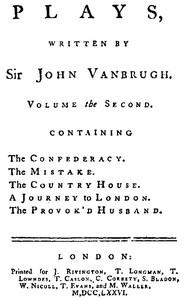
Plays, written by Sir John Vanbrugh, volume the second — Reading Companion can be approached with a clearer sense of reading commitment from its source measurements: 105,057 words, 7 hr 37 min estimated reading time, and 40 detected text sections.
The text analysis averages about 15.4 words per sentence, while the detected sections provide another way to judge how the source is divided.
Project Gutenberg metadata also associates the work with “Comedy plays,” connecting these edition facts with the source record’s subject description.
Explore this collection
These alternatives are selected using recorded categories and estimated reading time.
About 175 minutes
Fantasy Juvenile Worlds
40,150 recorded words. 282 minutes difference from this book's estimate.
View Gutenberg source #21849About 165 minutes
Fantasy Juvenile Worlds
37,943 recorded words. 292 minutes difference from this book's estimate.
View Gutenberg source #1192About 144 minutes
Fantasy Juvenile Worlds
32,918 recorded words. 313 minutes difference from this book's estimate.
View Gutenberg source #21334Search stored excerpts and compare books → Choose by your preferences →
Choices use stored catalog measurements. Estimates vary with reading speed. A shared category is a catalog label, not a claim that two books have the same argument or literary quality.
Search reads excerpt text stored with this catalog and links to its associated Gutenberg record. The connection is stored in the site database; this tool does not recheck that every excerpt is word-for-word identical to that external record. Excerpt search does not cover every chapter and does not verify historical publication dates.
Catalog snapshot checked: 2026-09-25. Coverage: 98 public books, 98 available source excerpts.
Read the complete public-domain text at its original source.
Read on Project GutenbergThe prologue spoken by a "Shabby Poet" sets a self-mocking tone: the speaker complains of poverty, ragged clothes, and a brother whose "decent plays" have earned him a laurel crown but little else. This meta-theatrical jab at the playwright's own trade recurs throughout the volume. In The Confederacy, the dramatis personae immediately signal a world of financial scheming: two rich money-scriveners named Gripe and Moneytrap, a gamester son, and a maid named Flippanta. The excerpts show that Vanbrugh's comedy depends on rapid, colloquial exchanges and characters defined by their appetites—for money, status, or pleasure.
The catalog subjects list this as comedy and 18th-century English drama, but the excerpts reveal a specific preoccupation: the transactional nature of marriage. In The Confederacy, Clarissa is described as an "expensive luxurious woman" who will "run in debt to all the shopkeepers" and lose money at cards while her husband earns at Westminster. The play's title itself suggests a secret alliance, likely between wives or servants against husbands. Vanbrugh's characters treat matrimony as a financial arrangement to be exploited or endured. The Country House and A Journey to London continue this theme: in the latter, John Moody's comic report of a journey full of contradiction—"Slap goes one thing, crack goes another"—mirrors the chaos of a household where the lady's desires clash with the coach's limitations. The humor arises from the gap between characters' self-interest and the disorder it creates.
Vanbrugh gives servants distinctive speech patterns that mark both region and rank. John Moody in A Journey to London speaks in a thick Northern dialect: "I'm staut still, and a faithful awd servant to th' family." His repeated exclamations—"Gadswookers," "murrain upon all rogues and whores"—contrast with the more polished but equally scheming language of his masters. The maid Flippanta in The Confederacy has a name that hints at her flippant, quick-witted role. These characters are not mere foils; they drive the plot through their observations and actions. The prologue's "Shabby Poet" also occupies a liminal status, neither fully inside nor outside the theatrical world. By giving servants and marginal figures strong voices, Vanbrugh broadens the social range of his comedy beyond the usual Restoration elite.
The prologue to this volume is unusual: it is spoken by a "Shabby Poet" who explicitly discusses the playwright's career. He mentions a brother who "writ for praise" and "meddling with some folks in black"—likely a reference to Vanbrugh's own clashes with the clergy over his earlier play The Relapse. The poet shows his ragged coat and laurel crown, complaining that the honor is worthless without means to eat. This self-referential opening frames the entire collection as the work of a writer aware of his precarious position in the literary marketplace. The prologue's structure—a series of complaints punctuated by gestures to the audience and the theater—mirrors the episodic, argument-driven style of the plays themselves. Readers encountering this volume should note how Vanbrugh uses the prologue to establish a tone of ironic self-deprecation that colors the comedies to follow.
Because the excerpts are drawn from multiple plays within the volume, readers should pay attention to how Vanbrugh varies his comic strategies: The Confederacy relies on intricate plotting among couples, while The Country House and A Journey to London lean on farcical arrivals and dialect humor. The Provok'd Husband, left unfinished by Vanbrugh and completed by Colley Cibber, may show a different hand. Approach each play as a distinct experiment in stage comedy, united by a skeptical view of human motives.
Vanbrugh’s scheming servants made me think of my grandmother’s house, where every whispered plot felt theatrical. This reminded me of a quieter warmth I found once in Christmas at McCarthy's — Reading Companion, whose domestic chaos felt less like satire and more like a held breath, a family holding together against the cold.
Answer a few questions and save a private reflection on this device.