1

The vampire cat — Story, Setting & Ideas
(0 User reviews)
1422
Project Gutenberg
2012
Not confirmed
One-act plays; Vampires -- Drama; Japan -- History -- 1185-1600 -- Drama
Readers of public-domain and historical texts
Project Gutenberg digital edition
en
Edition facts
Words
7,323
Reading time
32 min
Text sections
2
Before opening The vampire cat — Story, Setting & Ideas, the edition data offers a quick orientation: 7,323 words, 32 min estimated reading time, and 2 detected text sections.
The text analysis averages about 15.2 words per sentence, while the detected sections provide another way to judge how the source is divided.
Project Gutenberg metadata also associates the work with “One-act plays,” connecting these edition facts with the source record’s subject description.
Source:
Project Gutenberg record #40120
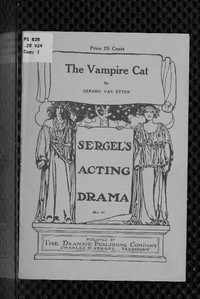
This editorial note examines Gerard Van Etten's one-act play based on the Japanese legend of the Nabeshima cat, focusing on authorial choices in diction, dialogue, and description that create atmosphere and tension within a medieval Japanese setting.
Read the complete public-domain text at its original source.
Read on Project GutenbergGerard Van Etten's The Vampire Cat adapts the Japanese legend of the Nabeshima cat into a one-act play set in medieval Japan. The play's brevity—a single scene between 10 and 12 p.m.—forces a concentrated use of language and stage direction. Van Etten's diction shifts between formal courtly speech and more intimate, anxious exchanges, as when O Toyo tells Kashiku to "sleep deeply, Breathing poppies," a line that blends command with a poetic, almost hypnotic quality. The dialogue often carries double meanings, hinting at hidden motives without explicit exposition.
Diction and the Language of Command
Van Etten's characters speak in short, imperative sentences that establish a clear hierarchy. Prince Hizen's lines are clipped and authoritative, while O Toyo's speech becomes increasingly fragmented as the play progresses. The maid Kashiku responds with deferential phrases like "My lady" and "It were a fitting thing to kiss thy lord," which contrast with O Toyo's later, more urgent commands: "Put out the lamps" and "Go." This shift in diction mirrors O Toyo's internal conflict and the growing supernatural influence. The playwright avoids lengthy explanations, letting the rhythm of command and obedience build tension.
Dialogue as a Tool for Ambiguity
Conversations in the play often circle around unspoken truths. When O Toyo asks Kashiku, "You have not heard me say strange things, Kashiku?" and Kashiku replies "I have heard—" only to be cut off by O Toyo's "Nothing," the exchange creates a deliberate gap between what is said and what is understood. This technique forces the audience to infer the threat. Similarly, O Toyo's repeated line "I shall kiss him—I shall kiss him!" becomes a refrain that shifts from longing to menace as the lantern glows. The dialogue rarely states the supernatural outright, leaving the cat's influence to be felt through repetition and interruption.
Description and the Use of Stage Directions
Van Etten's stage directions are unusually detailed for a one-act play, blending practical instructions with atmospheric cues. The opening description specifies a steel mirror, candles with "ornate shades," and a sleeping mat with an unlighted lantern—objects that later become central to the action. The direction for the lantern to "glow more and more brightly until a cat's head appears on it" is paired with a cautionary note: if the effect risks being "ludicrous," it should be replaced with a simpler glow. This reveals a playwright aware of his material's potential for absurdity, choosing restraint over spectacle. The final direction—"Instantly, in utter darkness, the curtain falls"—uses abruptness to maximize impact.
Structure and Pacing in a One-Act Format
The play's structure is tightly compressed: a single room, a two-hour window, and a small cast. Van Etten builds suspense through incremental revelations. The first half establishes normalcy—polite exchanges between the prince, his councillor, and the maid—before O Toyo's private scene with Kashiku introduces unease. The climax arrives swiftly: O Toyo rises "as in a trance," Ito Soda steps from behind a screen, and the stabbing is followed by immediate blackout. The playwright uses the screen as a visual device for hidden presence, and the cat-call from the garden as an auditory cue. This economy of means keeps the focus on the moment of transformation and violence.
Readers approaching The Vampire Cat should attend to how Van Etten balances the legend's supernatural elements with the constraints of amateur theatricals. The play's effectiveness depends on precise timing and the actors' ability to convey menace through understatement. The author's note about avoiding the "ludicrous" suggests that the piece is best performed with a straight-faced commitment to its eerie tone. Consider how the spare dialogue and deliberate stage directions create a space for the audience's imagination to fill the gaps.
I have often held The vampire cat close, its shadowed hallway of hungry silence lingering long after the page turns. There is a particular loneliness there, a justice that waits breathlessly. That same quiet patience lives in Justice — Themes and Context, as if both books share one slow heartbeat beneath different cloth. A rare, gentle kinship, discovered only by those who read late.
There are no reviews for this eBook.
There are no comments for this eBook.
Reader reflection
What did you think of this book?
Answer a few questions and save a private reflection on this device.
Your progress
0
/
10
2
Did this book hold your interest?
3
Would you recommend this book to another reader?
4
Did the language feel accessible?
5
How strong was your personal connection to the text?
6
Did the book offer a fresh perspective?
7
How clearly were the main ideas presented?
8
How strongly did the book affect you emotionally?
9
In one sentence, what did you learn?
10