1

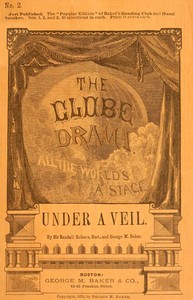
Under a Veil: A Comedietta in One Act — Key Ideas to Explore
(0 User reviews)
2709
Project Gutenberg
2016
Not confirmed
Drama; Comedy plays
Readers of public-domain and historical texts
Project Gutenberg digital edition
en
Edition facts
Words
11,752
Reading time
52 min
Text sections
4
The catalog record for Under a Veil: A Comedietta in One Act — Key Ideas to Explore provides practical reading context through 11,752 words, 52 min estimated reading time, and 4 detected text sections.
The text analysis averages about 10.6 words per sentence, while the detected sections provide another way to judge how the source is divided.
Project Gutenberg metadata also associates the work with “Drama,” connecting these edition facts with the source record’s subject description.
Source:
Project Gutenberg record #52764
An 1876 one-act comedietta by Sir Randal Roberts and George M. Baker, built on mistaken identities and a masked romance. The dialogue relies on rapid, witty exchanges and stage business, with characters speaking in asides and soliloquies. The play's humor emerges from near-misses and concealed identities, particularly through a sprig of flowers used as a moral prop.
Read the complete public-domain text at its original source.
Read on Project GutenbergThe play opens with a striking stage direction: a woman veiled, a man in an adjoining room, and a locked door between them. From the first lines, the authors establish a pattern of near-misses and concealed identities. Lucy, the veiled woman, delivers a mock-lecture to the unseen Charles, using a sprig of flowers as a prop to argue against violence. The dialogue is brisk, with characters frequently speaking in asides or soliloquies, revealing thoughts the other cannot hear. The humor derives from these parallel tracks of misunderstanding, as when Charles, alone, laments that the woman he pursues is always masked, while Lucy, alone, rejoices in having secured his promise.
Diction and the Rhetoric of Concealment
The characters’ language oscillates between formal politeness and impulsive exclamation. Lucy’s speeches are measured, almost pedagogical—she delivers a “lecture” on the sprig’s sentimental value—while Charles erupts in theatrical despair: “No, no! I have no longer any such desire.” The authors use repetition for comic effect: Charles’s pleas “I implore you! I beseech you!” are undercut by Lucy’s calm refusal. The maid Elizabeth speaks in a lower register, with colloquial asides (“She’s been up to something, I know”), creating a class-based contrast in diction. This layering of voices keeps the audience aware of who knows what, and who is mistaken.
Stage Business and the Physical Comedy of Doors
The play’s structure depends on doors, keys, and missed entrances. Stage directions specify doors at left, right, and center, with characters slipping in and out just as others approach. The key falls out of the lock, Lucy bolts the door, Charles slams his—each action drives the plot. The authors exploit these physical elements for both suspense and farce. When Charles enters Lucy’s room by mistake, the comedy hinges on timing: he takes a candle, sees her face, and recoils with “Confound it!” The audience sees the recognition before he does. The repeated pattern of one character exiting as another enters creates a rhythm of near-discovery that sustains the one-act format.
The Sprig as Symbol and Plot Device
Lucy’s sprig of flowers is more than a prop; it carries the play’s moral argument. She uses it to argue that even a violent man would be softened by memories of childhood and mother. Charles seizes it as a token of his change of heart. The sprig thus becomes a physical link between the characters’ emotional states—Lucy’s hope, Charles’s conversion. Yet the authors undercut this sentimentality with irony: Charles’s vow is made to a veiled woman whose face he has not seen. The sprig’s symbolic weight is balanced by the farcical context, preventing the scene from becoming mawkish. It is a rare moment of earnestness in a play otherwise built on deception.
Asides and the Audience’s Privileged View
The playwrights frequently break the fourth wall through asides, allowing characters to confide in the audience. Lucy’s “Ah, how my heart beats!” and Charles’s “Another dream, that takes itself off to the land of dreams” are spoken directly to the house. These asides create a gap between what characters know and what the audience knows—a gap that generates both suspense and laughter. The technique also reveals the characters’ self-awareness: they know they are in a comedy of errors. Elizabeth’s aside after finding the key (“She’s been up to something, I know”) aligns the maid with the audience as a knowing observer. This shared perspective makes the eventual unmasking more satisfying.
Readers should attend to the play’s stage directions as carefully as its dialogue. The authors specify every gesture, every door slam, every pause. The comedy depends on these physical cues, which may be less apparent in a reading than in performance. Imagining the timing of entrances and exits—the near-misses, the overlapping speeches—will reveal the craft behind the farce. The play rewards attention to its small details: a dropped key, a sprig of flowers, a name discovered on a dressing-case.
This little farce’s masked romance brought back an evening in my grandmother’s parlor, where misunderstandings bloomed like that sprig of flowers. Her At Hotel On-de-Blink — Reading Notes gave me the same gentle ache, a reminder that laughter often hides a quiet sorrow beneath its patter. How strange that such lightness can feel so much like home.
There are no reviews for this eBook.
There are no comments for this eBook.
Reader reflection
How will you remember this book?
Save your reaction, strongest insight, and memorable passage.
Your progress
0
/
10
2
How much did you enjoy the reading experience?
3
Would you recommend this book to another reader?
4
How much effort did this book require?
5
Which element worked best for you?
6
How would you rate its originality?
7
Did it raise ideas you would like to talk about?
8
Did this book create an emotional response?
9
Which lesson or insight stayed with you?
10