1

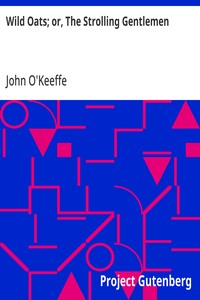
Wild Oats; or, The Strolling Gentlemen — Key Ideas to Explore
(0 User reviews)
1403
Project Gutenberg
2012
Not confirmed
Comedy plays; English drama
Readers of public-domain and historical texts
Project Gutenberg digital edition
en
Edition facts
Words
24,657
Reading time
108 min
Text sections
4
The catalog record for Wild Oats; or, The Strolling Gentlemen — Key Ideas to Explore provides practical reading context through 24,657 words, 1 hr 48 min estimated reading time, and 4 detected text sections.
The text analysis averages about 13.7 words per sentence, while the detected sections provide another way to judge how the source is divided.
Project Gutenberg metadata also associates the work with “Comedy plays,” connecting these edition facts with the source record’s subject description.
Source:
Project Gutenberg record #39060
John O'Keeffe's 1791 comedy follows mistaken identities and theatrical schemes among a blind playwright's characters, with Lady Amaranth defending Shakespeare against Puritan Ephraim Smooth's condemnations.
Editorial Edition Score
4.6/5
★★★★★
★★★★★
Calculated from edition completeness, EPUB availability, text structure and catalogue metadata. Not a user rating.
How this score is calculated
- Description quality20 pts
- Title & short description10 pts
- Source metadata20 pts
- Text length15 pts
- Chapters / structure15 pts
- EPUB file integrity20 pts
Total of 100 points, scaled to a 2.5-5.0 range. Editions with an empty description or a missing EPUB file are not scored.
Edition quality
Read the complete public-domain text at its original source.
Read on Project GutenbergJohn O'Keeffe's Wild Oats; or, The Strolling Gentlemen (1791) is a five-act comedy that weaves theatricality into its plot and dialogue. The play's title page notes it was performed at the Theatre Royal, Covent Garden, and the text includes remarks by Mrs. Inchbald, who describes O'Keeffe as a blind author whose "mind supports with resignation his bitter calamity." The excerpts reveal a work preoccupied with performance: characters discuss acting, read playbooks, and prepare to stage Shakespeare's As You Like It. The catalog subjects list only "Comedy plays" and "English drama," but the text itself engages directly with the moral status of theatre, a theme absent from those labels.
Theatrical Self-Awareness in Dialogue and Action
The excerpts show characters who are acutely conscious of theatre as both an art form and a social practice. Lady Amaranth reads a book given by her cousin Harry, which she identifies as Shakespeare, and she reflects on the stage as "the vehicle of delight and morality." This meta-theatrical moment is reinforced when Jane announces that Harry has chosen As You Like It for a performance, and Ephraim Smooth objects vehemently, calling a playhouse "the school for the old dragon." The play thus dramatizes a conflict between Puritan suspicion of drama and Enlightenment defenses of its moral utility. O'Keeffe does not merely write a comedy; he writes a comedy about the value of comedy itself.
Mistaken Identities and the Limits of the Excerpts
The surviving dialogue from Act III involves a confusion over Harry's whereabouts. Sir George believes John Dory brought Harry to Lady Amaranth's house, but Harry denies it. John insists he did, and the argument escalates into threats of violence and disinheritance. This scene typifies the comedy of errors that the catalog subject "Comedy plays" implies, but the excerpts do not reveal the full resolution. The reader cannot determine whether Harry is indeed Sir George's son, whether he has met Lady Amaranth, or how the identity of "Dick Buskin" (Harry's alias) will be untangled. The text provides only fragments of the plot's machinery, leaving the larger narrative arc inferred rather than confirmed.
Religious Language and Comic Conflict
Ephraim Smooth speaks in a stylized biblical idiom that contrasts sharply with the other characters' more naturalistic dialogue. He calls the mansion "the tabernacle of Baal" and declares that "a playbook [is] the primer of Belzebub." Lady Amaranth counters by quoting Shakespeare's Measure for Measure on mercy, asking, "Doth Belzebub speak such words?" This exchange uses religious rhetoric to frame the central ideological tension of the play: whether theatre corrupts or edifies. O'Keeffe, himself blind and dependent on the audience's laughter, stages this debate without resolving it in the excerpts, leaving the reader to wonder how the comedy will reconcile Ephraim's condemnation with the play's own existence.
Because the excerpts cover only portions of Acts III and IV, the reader encounters a play rich in theatrical self-reference and ideological conflict but incomplete in its plot development. Pay attention to how O'Keeffe uses the device of a play-within-a-play to mirror the audience's own experience of watching Wild Oats. The contrast between Ephraim's scriptural cadences and the other characters' speech also rewards close reading, as it signals a deeper argument about the legitimacy of comedy as a moral form.
That rainy afternoon, Wild Oats kept me company, its mistaken identities a gentle chaos against the window’s patter. Blind playwrights and Puritans arguing about Shakespeare felt strangely cozy, almost like eavesdropping on old friends. Later, I reached for something quieter on the shelf and found a cold, white stillness. That shift—from bustling farce to silent expanse—felt natural, like turning a page. It made me pause and drift toward The snow man — Edition Insights.
There are no reviews for this eBook.
There are no comments for this eBook.
Reader reflection
Your personal reading reflection
Build a private reading journal entry for this title.
Your progress
0
/
10
2
How did the book work for you overall?
3
Would you encourage someone else to read it?
4
How easy was the book to follow?
5
Would you start a conversation about this book?
6
Was the book moving at the right speed?
7
Was the book easy to understand?
8
Did the book offer a fresh perspective?
9
What did this book teach you most?
10