1

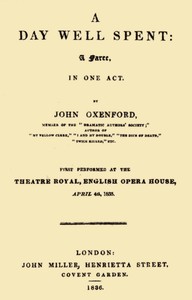
A Day Well Spent: A Farce, in One Act — Text and Context
24
10
Project Gutenberg
2015
Comedy plays; English drama -- 19th century
Readers of public-domain and historical texts
Project Gutenberg digital edition
en
Edition facts
Words: 12,248
Reading time: 54 min
Text sections: 4
Source:
Project Gutenberg record #49882
John Oxenford's 1835 farce follows hosier Cotton's foreman and apprentice as they impersonate their employer and each other, triggering a cascade of mistaken identities, romantic complications, and comic chaos across multiple London settings.
Editorial Edition Score
4.5/5
★★★★★
★★★★★
Calculated from edition completeness, EPUB availability, text structure and catalogue metadata. Not a user rating.
Edition quality
John Oxenford's A Day Well Spent (1835) opens with hosier Cotton lamenting a day away from his shop to visit a wealthy relation. He trusts his foreman Bolt and apprentice Mizzle to manage the business—then immediately undercuts that trust by comparing them to the notorious apprentice George Barnwell. The play wastes no time establishing its comic engine: within the first scene, the adventurer Cutaway enters looking for a young lady, and the audience learns that Cotton's daughter Harriet has her own designs. The farce's rapid-fire entrances, asides, and self-conscious bows (Cutaway is later introduced to himself) signal a world where identity is fluid and every character is eager to play a part.
Doubles and Disguises
The excerpts reveal a persistent pattern of doubling. Cutaway is literally introduced to himself when Bolt impersonates him; Mizzle dons a cloak and bonnet to pass as Harriet; and a second Harriet appears at Mrs. Chargely's house, causing consternation. The play's structure—nine scenes in a single act—allows these confusions to multiply quickly. Oxenford uses costume and props (a veil, a ladder) to drive the plot rather than lengthy exposition. Readers should watch for how each character's attempt to assume another identity backfires, often producing a line that undercuts the disguise itself, such as Mizzle's remark, "A second me will walk in next."
The Language of Farce
Oxenford's dialogue relies on short, punchy exchanges and frequent asides that reveal characters' true thoughts. Cotton's aside "Puppy!" after Cutaway's banter, or Bolt's muttered "Not at all!" when asked how he likes himself, give the audience a private joke. The playwright also uses repetition for comic effect: characters echo each other's words ("Who?" / "Mr. Cotton") and exclamations ("I am petrified! thunderstruck!"). These verbal tics create a rhythm that propels the action forward. The farce's one-act form means every line must serve the plot or the laugh; there is little room for reflection.
Social Hierarchies in Motion
The dramatis personae lists characters by social type: the hosier, the foreman "quite a gentleman," the apprentice "wishing to be a gentleman," and the outright rogue Sam Newgate ("no gentleman"). The play's comedy often springs from characters straining against or exploiting these labels. Bolt and Mizzle, left in charge, immediately begin acting above their station; Cutaway, an "adventurous gentleman," treats Cotton with breezy familiarity. Mrs. Chargely, a "beneficent lady," tries to protect Harriet but is repeatedly outmaneuvered. The farce suggests that social roles are costumes as easily swapped as a veil or cloak.
The Architecture of Confusion
Oxenford's scene headings map a tight geography: Cotton's house, a street, Mrs. Stitchley's room, an inn, a chamber, Mrs. Chargely's room and garden, a shop exterior, and another chamber. The action moves through these spaces rapidly, with characters entering and exiting through doors, windows, and a Gothic window. The garden scene (Scene VII) features a high wall, a fastened gate, and a ladder—physical obstacles that mirror the social barriers characters try to cross. The final excerpt shows Bolt hiding among statues while Mizzle watches from a window, a visual encapsulation of the farce's central tension: everyone is both observer and observed.
Because the excerpts cover only the opening and middle scenes, the resolution remains unknown. Readers should attend to how Oxenford resolves the multiple impersonations and whether the title's irony—"a day well spent"—is confirmed or undercut. The play's rapid scene changes and reliance on physical comedy reward a reading that visualizes the stage action. Pay particular attention to the final lines of each scene, which often deliver a punchline or a cliffhanger that propels the next confusion.
Reader reflection
How did this book work for you?
Your answers remain private and are stored only in this browser.
Your progress
0
/
10
2
What was your overall reaction to the book?
3
Would you recommend this book to another reader?
4
How easy was the book to follow?
5
Did any part of the book stay with you emotionally?
6
How distinctive were its ideas or approach?
7
How clearly were the main ideas presented?
8
How well did it match your expectations?
9
What did this book teach you most?
10