1

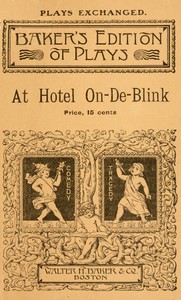
At Hotel On-de-Blink — Reading Notes
28
10
Project Gutenberg
2023
Drama; Comedy plays; Farces
Readers of public-domain and historical texts
Project Gutenberg digital edition
en
Edition facts
Words: 13,042
Reading time: 57 min
Text sections: 10
Source:
Project Gutenberg record #70211
A two-part farce set in a comically mismanaged hotel, where a Dutch proprietor, a tramp, a lost Italian, and a baby doll drive the humor through exaggerated dialects, absurd props, and running gags.
The play opens with a stage set for chaos: a hotel counter, a lamp, and a newspaper, but the real comedy lies in the props. Signs advertise "Tripe, 5c. a yard" and "Board, 5c. a foot," establishing a world where logic is bent for laughs. Hans Seitz, the proprietor who "owns der blace" but is not the proprietor, speaks in a thick Dutch dialect, immediately signaling the farcical tone. The character list includes a "knight of the road" (tramp), a "lost dago," and a baby doll—a prop that will later drive a key gag. The play is structured in two parts, suggesting a build-up of comic situations rather than a tight plot.
Dialect as a Comic Engine
From the first lines, the humor relies on exaggerated accents. Hans Seitz's Dutch dialect—"I bane tink"—and Gretch's similar speech create a linguistic barrier that other characters exploit. The tramp Samp L. Case speaks in a folksy, American vernacular, while Antonio Bootlashoesa Morecheesa is described as a "lost dago," likely using Italian-inflected English. The play does not aim for realism; instead, these dialects are shorthand for character types, each with predictable comic responses. The audience is expected to laugh at mispronunciations and misunderstandings, a staple of early 20th-century farce.
Props and Physical Comedy
The property list is a treasure map to the humor: a baby doll, a grip (suitcase), and absurd signs. The baby doll is not a real infant but a prop for Gretch to fetch on cue, likely leading to a sight gag. The signs—"Eye scream, 10c. a porchun"—are visual puns that set the tone before a word is spoken. The play's structure as "an entertainment in two parts" suggests a series of set pieces rather than a continuous narrative. The costumes also contribute: Hans wears a suit "much too large" and a red handkerchief, emphasizing his bumbling nature. Physical comedy, from oversized clothing to prop mishaps, drives the action.
The Unreliable Proprietor
Hans Seitz is introduced as "not proprietor; he 'owns der blace,'" a paradoxical description that hints at his incompetence. He is likely the butt of jokes about running a hotel where nothing works. The character list notes he should be played by a "very stout person," adding to his buffoonish image. His daughter Gretch is described as "Dutch b..." (cut off in the excerpt), but her role seems to involve fetching the baby doll and possibly romantic subplots. The tramp Samp L. Case, a "knight of the road," is a classic farce character who disrupts the hotel's routine. The interplay between these mismatched characters—a pompous but clueless host, a wandering con man, and a lost foreigner—creates a recipe for escalating misunderstandings.
The Baby Doll Gag and Its Payoff
The excerpt includes a fragment of dialogue: "covered it over. Then when he got quite warm and comfortable, in the deepest sense of gratitude the little feller looked up at me and said—— Weber. Papa." This appears to be a punchline involving the baby doll, where a character (likely Hans) mistakes the doll for a real baby and imagines it speaking. The line "Weber. Papa" suggests a misattributed parentage, a classic farce trope. The baby doll, listed as a property, is central to this gag. The play likely builds to this moment, where the absurdity of a grown man treating a doll as his child culminates in a ridiculous revelation. The audience's laughter depends on the contrast between the serious delivery and the obvious prop.
Readers should approach At Hotel On-de-Blink as a performance piece, not a literary text. The humor is visual and auditory, relying on accents, props, and physical comedy. The two-part structure suggests a quick pace, with each scene escalating the absurdity. Pay attention to the stage directions and property list—they are the key to the jokes. The play is best enjoyed when imagined on stage, with exaggerated acting and a willingness to laugh at the ridiculous.
Reader reflection
Your personal reading reflection
Build a private reading journal entry for this title.
Your progress
0
/
10
2
What was your overall reaction to the book?
3
How likely are you to recommend this book?
4
What was the reading difficulty like?
5
How much did the book move you?
6
Would a second reading be valuable?
7
How understandable was the text?
8
Did you gain anything practical from the text?
9
What changed or sharpened your thinking?
10