1

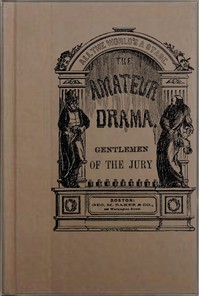
Gentlemen of the Jury: A Farce — Edition Insights
26
9
Project Gutenberg
2015
Comedy plays; American drama -- 19th century; Jury -- Drama
Readers of public-domain and historical texts
Project Gutenberg digital edition
en
Edition facts
Words: 9,013
Reading time: 40 min
Text sections: 2
Source:
Project Gutenberg record #48707
In this one-act farce, George M. Baker uses a jury room standoff and a box of sawdust to expose the gap between legal solemnity and human folly. The play's rapid-fire dialogue, physical comedy, and character names like Precise and Timorous reveal Baker's craft in blending humor with pointed social observation.
Editorial Edition Score
4.5/5
★★★★★
★★★★★
Calculated from edition completeness, EPUB availability, text structure and catalogue metadata. Not a user rating.
Edition quality
George M. Baker's Gentlemen of the Jury: A Farce opens not in a courtroom but in a jury room already thick with comic tension. The play's twelve male characters—bearing names like Precise, Timorous, and O'Rourke—are immediately at odds, their arguments spilling into physical comedy. Baker wastes no time establishing the farce's central device: a matchbox that Short, a juror, brandishes as if it contains gunpowder, threatening to blow up the room unless the jury reaches a verdict. This prop becomes the fulcrum for the play's satire of legal deliberation.
Diction as Characterization
Baker assigns each juror a distinctive speech pattern that telegraphs personality. Precise speaks in clipped, formal phrases: “Gentlemen, listen to your verdict.” O'Rourke's Irish dialect is thick with exclamations: “By me soul! I say a wake a comin' for the last of the O'Rourkes.” Snowball, the lone Black character, is given a dialect that veers into stereotype: “By golly, I'm all ob a hot chill in my backbone.” These vocal tics are not merely decorative; they drive the comedy by creating friction between characters who cannot understand one another. The dialogue's rhythm—staccato interruptions, overlapping cries of “Help! Murder! Help!”—mirrors the chaos of a jury that cannot agree.
The Prop as Plot Engine
The matchbox—revealed at the climax to contain only sawdust—is the play's most economical authorial choice. Short uses it to force a verdict: “Shall I apply it, or are you ready with a verdict?” The jurors' panic is physical: they “try to get behind each other,” kick, and strike. Baker stages the farce as a series of escalating physical reactions to a single object. The sawdust twist undercuts the jury's solemnity: “You thought 'twas gunpowder. No matter. I saw I could throw dust in your eyes with it.” The prop thus becomes a metaphor for the emptiness of legal posturing.
Structure and Pacing
Baker compresses the entire action into a single room and a short span of stage time. The play's 9,013 words move through a tight arc: deadlock, threat, panic, verdict, revelation. The climax arrives when Short holds the match and the jurors shout contradictory commands—“No. Yes. Verdict. Verdict.”—before capitulating. The curtain falls immediately after the sawdust reveal, leaving no room for reflection. This breakneck pace is typical of farce, but Baker uses it to underscore the absurdity of a legal system that can be resolved by a trick.
Social Satire Through Names
Baker's character names function as shorthand for social types. Precise suggests a stickler for procedure; Timorous, a coward; Jolly, a buffoon; Strongfist, a bully. These names allow the audience to instantly grasp each juror's role in the comic machinery. The defendant, Peleg Popgun, is never seen—his name alone evokes a harmless, ridiculous figure. The play's subtitle, “A Farce,” signals that Baker is less interested in realism than in exaggeration. Yet the names also carry a satirical edge: the jury is composed not of impartial citizens but of caricatures, each too flawed to render justice.
The Verdict as Punchline
The final verdict—“guilty”—is extracted under duress, not deliberation. Baker leaves the actual case unresolved; the play's focus is entirely on the jury's behavior. Short's closing speech punctures any remaining dignity: “You're like all the rest of this universal Yankee nation—anxious to fasten your tongue tackle on to every question.” The phrase “universal Yankee nation” broadens the satire from a single jury to a national trait of meddlesome argument. The sawdust, he concludes, “proved a better medicine than Popgun's celebrated Dead Shot.” The joke lands on the jurors themselves.
Readers approaching Gentlemen of the Jury should attend to Baker's stage directions, which are as much a part of the comedy as the dialogue. The physical business—kicks, falls, huddling—is carefully choreographed to amplify the verbal sparring. The play rewards attention to its prop economy: every object, from the matchbox to the verdict papers, serves a comic or thematic purpose. For those interested in nineteenth-century amateur theater, this farce offers a compact example of how Baker tailored his material for home performance, with a cast of twelve male roles and minimal set requirements.
Reader reflection
How did this book work for you?
Your answers remain private and are stored only in this browser.
Your progress
0
/
10
2
Was reading this book enjoyable?
3
How likely are you to recommend this book?
4
What was the reading difficulty like?
5
Could you apply anything you learned?
6
How strong was your personal connection to the text?
7
What did you appreciate most?
8
How would you rate its originality?
9
What did this book teach you most?
10