1

Ludus Coventriæ — A Reader’s Guide
25
13
Project Gutenberg
2023
Mysteries and miracle-plays, English; English drama -- To 1500; English language -- Middle English, 1100-1500 -- Glossaries, vocabularies, etc.
Readers of public-domain and historical texts
Project Gutenberg digital edition
en
Edition facts
Words: 103,778
Reading time: 452 min
Text sections: 53
Source:
Project Gutenberg record #70646
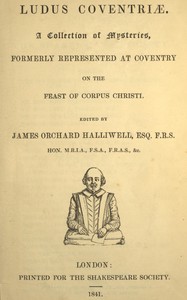
This edition of the Coventry mystery plays, edited by J. O. Halliwell-Phillipps for the Shakespeare Society in 1841, presents Middle English biblical dramas with a glossary. The excerpt from the raising of Lazarus shows dialogue-driven narrative, metrical variation, and colloquial speech patterns that reveal the playwrights' choices in adapting scripture for performance.
Editorial Edition Score
4.9/5
★★★★★
★★★★★
Calculated from edition completeness, EPUB availability, text structure and catalogue metadata. Not a user rating.
Edition quality
The Coventry mystery plays, preserved in this 1841 edition edited by J. O. Halliwell-Phillipps, offer a window into the dramatic and linguistic choices of late medieval playwrights. The excerpt from the raising of Lazarus (lines 1–100) illustrates how the anonymous authors transformed biblical narrative into dialogue-heavy scenes, with characters like Jesus, Martha, and Mary Magdalene speaking in varied verse forms. The text's Middle English orthography—such as 'xal' for 'shall' and 'ȝour' for 'your'—preserves the original pronunciation and regional dialect, while the stage directions implied in the speech (e.g., 'Com forthe, bretheryn') hint at the physical movement of actors on pageant wagons.
Dialogue as Dramatic Engine
The Lazarus scene relies almost entirely on dialogue to advance the plot and convey emotion. Characters speak in alternating stanzas, often with rapid exchanges that mimic conversational turn-taking. For instance, the messenger's report of Lazarus's illness ('With grett syknes is sore dyssesyd') is immediately countered by Jesus's theological reinterpretation ('Dedly syknes Laȝarus hath non'). This back-and-forth creates tension and clarifies the miracle's purpose. The playwrights avoid lengthy narration, instead letting characters reveal their concerns—Martha's grief ('A! gracyous Lord, had ȝe ben here'), Thomas's fatalism ('lete us deye with hym togedyr')—through direct speech. The dialogue also serves to instruct the audience: Jesus's explanation of day and night as metaphors for faith and doubt ('He xal not stomble ageyn hylle nor pleyn, / That goth the wey whyl it is day lyght') is a catechism embedded in drama.
Metrical Variety and Verbal Texture
The verse form is not uniform. Most lines are in rhyming quatrains (abab), but the meter shifts between iambic and accentual rhythms, reflecting the flexibility of Middle English prosody. Some lines are end-stopped and regular ('Xij. owrys the day hathe in certeyn'), while others are enjambed and colloquial ('Oute of myn herte alle care to lete, / Alle sorwe and wo to caste away'). The playwrights also use internal rhyme and alliteration for emphasis: 'grym and grylle,' 'clere and bryght.' The vocabulary mixes elevated religious terms ('Godhede,' 'gloryfie') with everyday words ('brayde' for 'moment,' 'rape' for 'haste'), creating a register that is both solemn and accessible. The glossary in Halliwell-Phillipps's edition helps modern readers navigate obsolete terms like 'myrkenes' (darkness) and 'stomble' (stumble), revealing the linguistic gap between the original audience and today's.
Characterization through Speech Patterns
Each character in the Lazarus scene speaks with a distinct voice. Jesus uses authoritative, declarative statements ('I xal come to hem whan that I may') and theological explanations, while the disciples express doubt and fear ('The Jewys ageyn the were grym and grylle'). Martha's speech is direct and emotional, mixing lament with faith ('ȝitt now I knowe withowtyn drede'). Mary Magdalene, by contrast, is given softer, more introspective lines ('Myn hed doth ake, as it xulde brest'). The consolators speak in proverbial wisdom ('Deth to no wyht can be a frende'), offering generic comfort that contrasts with the specificity of the main characters' grief. These linguistic distinctions suggest the playwrights were attentive to social roles and emotional states, even within a formulaic biblical framework.
Stagecraft Implied in the Text
Although the manuscript lacks explicit stage directions, the dialogue contains cues for action and staging. Jesus's command 'Com forthe, bretheryn, walke we oure way' indicates a processional movement, likely across the pageant wagon's platform. The messenger's repeated entrances and exits ('Goo hom ageyn,' 'Alle heyl!') suggest multiple playing levels or doors. The reference to a 'grett stone stoppyth the pyttys gate' implies a visible tomb prop. The consolators' offer to 'abyde' with Mary while Martha goes to meet Jesus hints at simultaneous action on different parts of the stage. These embedded directions show that the playwrights conceived the plays as physical performances, not just recitations, and that the audience was expected to follow multiple character groups through dialogue alone.
Readers approaching this edition should attend to the interplay between theological instruction and theatrical practicality. The Middle English text rewards slow reading, especially with the glossary at hand, as the playwrights' word choices often carry double meanings—'slepynge' as both literal sleep and death, 'day lyght' as both time of day and spiritual clarity. Comparing this version to the biblical source in the Gospel of John reveals how the dramatists expanded minor characters (the consolators, the messenger) and compressed narrative into dialogue. The edition's introduction by Halliwell-Phillipps also contextualizes the plays within the Corpus Christi festival, but the text itself offers the richest evidence of medieval dramatic craft.
Reader reflection
How did this book work for you?
Your answers remain private and are stored only in this browser.
Your progress
0
/
10
2
How did the book work for you overall?
3
Would you pass this book on to a friend?
4
How much effort did this book require?
5
Which element worked best for you?
6
How would you describe its reading pace?
7
Would you read this book again?
8
Would this book work well in a reading group?
9
Which lesson or insight stayed with you?
10