1

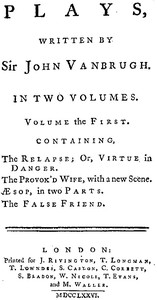
Plays, written by Sir John Vanbrugh, volume the first — Reading Notes
26
12
Project Gutenberg
2016
Comedy plays; English drama -- 18th century; English drama -- Restoration, 1660-1700
Readers of public-domain and historical texts
Project Gutenberg digital edition
en
Edition facts
Words: 115,044
Reading time: 501 min
Text sections: 39
Source:
Project Gutenberg record #51113
This volume collects four comedies by Sir John Vanbrugh, including 'The Relapse' and 'The Provok'd Wife,' showcasing his sharp dialogue, intricate plotting, and satirical view of Restoration marriage and manners.
Editorial Edition Score
4.9/5
★★★★★
★★★★★
Calculated from edition completeness, EPUB availability, text structure and catalogue metadata. Not a user rating.
Edition quality
Sir John Vanbrugh's dialogue crackles with a distinctive blend of wit and brutality. In the excerpt from The Provok'd Wife, Sir John Brute's drunken homecoming—'Sound as a Roach, Wife'—is met with Lady Brute's feigned concern, a scene that lays bare the couple's mutual contempt through clipped, aggressive exchanges. Vanbrugh's characters often speak in a rapid volley of insults and asides, revealing their true thoughts while maintaining a veneer of civility. This volume, containing four plays, offers a concentrated view of his authorial choices in diction and structure.
Dialogue as Weapon and Mask
Vanbrugh's characters rarely say what they mean directly. In the excerpt, Lady Brute's aside—'He stinks like Poison'—contradicts her spoken concern, creating a dramatic irony that the audience shares. Sir John's response, 'I see it goes damnably against your Stomach—And therefore—Kiss me again,' turns her performance into a cruel game. This layering of public speech and private thought is a hallmark of Vanbrugh's style. He uses short, punchy lines to accelerate tension, as when Sir John bursts into the closet and greets the hidden gallants with mock civility: 'I give you many Thanks—I see you take Care of my Family.' The politeness is a thin cover for rage, and the audience feels the imminent explosion.
The Physicality of Farce and Violence
Vanbrugh's stage directions and dialogue emphasize bodily action. Sir John enters 'all dirt and bloody,' and the stage business of kissing, tumbling, and kicking open a door is integral to the comedy. The line 'we may go pig together' reduces marriage to a shared filth. This physicality extends to props: the 'cold Tea' in the closet becomes a euphemism for hidden lovers, and the broken lock is a flimsy excuse. Vanbrugh does not shy from showing the mess of human behavior—drunkenness, lust, and violence are presented without moral gloss. The farcical elements, such as the two gallants hiding in the closet, are grounded in a realistic depiction of domestic chaos.
Marriage as a Battle of Wills
The Brute marriage is a war of attrition. Lady Brute's attempts to manage her husband—'Pray, go to Bed; let me intreat you'—are met with suspicion and aggression. Sir John's line 'You know—I think you lye' encapsulates the distrust that underpins their relationship. Vanbrugh presents marriage not as a romantic union but as a power struggle, where each partner uses deception and manipulation. The gallants Constant and Heartfree are complicit in this game, treating Lady Brute as a prize to be won. The play's subtitle, 'Virtue in Danger,' is ironic: virtue is less a moral quality than a social performance. Vanbrugh's unsentimental view of matrimony reflects Restoration cynicism, but his dialogue gives it a sharp, personal edge.
Structure and the Art of the Reveal
Vanbrugh's plotting relies on carefully timed revelations. In the excerpt, the audience knows the gallants are in the closet long before Sir John discovers them, creating suspense. The burst door is a physical climax that releases the tension built through Lady Brute's lies. Vanbrugh often uses a pattern of concealment and exposure, where characters' schemes unravel in public. This structural choice heightens the comedy and reinforces the theme that secrets cannot be kept. The scene also demonstrates Vanbrugh's economy: the entire confrontation unfolds in a few pages, with no wasted lines. Each character's entrance and exit is motivated by the need to maintain or expose a facade.
Readers approaching this volume should attend to the rhythm of Vanbrugh's lines—the way he balances formal address with crude insult, and how asides puncture the surface of polite conversation. The plays reward attention to stage business and the physical comedy embedded in the text. Consider how Vanbrugh's choices in diction and structure create a world where wit is a weapon and marriage a battlefield.
Reader reflection
Your personal reading reflection
Build a private reading journal entry for this title.
Your progress
0
/
10
2
Was reading this book enjoyable?
3
Would you pass this book on to a friend?
4
How demanding did the text feel?
5
Did anything about the book feel genuinely new?
6
Would you like to discuss this book with someone?
7
Did you gain anything practical from the text?
8
Was the book easy to understand?
9
What is the main idea you are taking away?
10