1

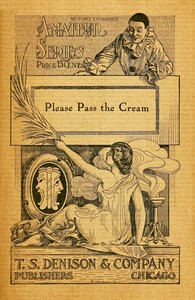
Please pass the cream: A comedy — Edition Insights
29
12
Project Gutenberg
2022
Comedy plays; Manners and customs -- Drama; Husband and wife -- Drama
Readers of public-domain and historical texts
Project Gutenberg digital edition
en
Edition facts
Words: 6,648
Reading time: 29 min
Text sections: 5
Source:
Project Gutenberg record #68147
A one-act comedy from 1918 in which a husband and wife's breakfast-table quarrel over grammar, cream, and a cherished heirloom pitcher escalates into a theatrical display of marital tension and wordplay.
Editorial Edition Score
4.5/5
★★★★★
★★★★★
Calculated from edition completeness, EPUB availability, text structure and catalogue metadata. Not a user rating.
Edition quality
The play opens at a breakfast table set for two, with Mr. and Mrs. Clark seated at opposite ends. Within moments, the dialogue pivots on a single grammatical error: Mrs. Clark corrects her husband’s “it don’t,” and he counters with “ain’t.” This exchange establishes a pattern of linguistic sparring that drives the entire twenty-minute piece. The stage directions specify a cosy dining-room in dark tones, a sideboard with silver, and a telephone on a small table—details that ground the domestic setting. Holmes uses the cream pitcher as both a prop and a symbol, its presence announced in the opening description and its fate sealed in the final moments.
Grammar as a Weapon
The Clarks’ conflict is waged primarily through language. Mrs. Clark repeatedly corrects her husband’s grammar—“it don’t,” “ain’t”—while he feigns ignorance or deflects with humour. When she accuses him of breaking an engagement promise to stop saying “ain’t,” he replies, “I ain’t quite sure that I made such a promise.” This retort turns her own correction back on her, a tactic he uses again later. The script highlights a class or educational divide: Mr. Clark is described as a “self-made man,” while Mrs. Clark is a “former schoolma’am.” Her insistence on proper English clashes with his deliberate nonchalance. The telephone call to Mrs. Williams introduces a third party who agrees with Mrs. Clark, but Mr. Clark dismisses this as deference to a wife. The argument escalates not through physical action but through verbal repetition and escalation, culminating in Mrs. Clark’s explosive denial: “I never said ain’t—never—never—never!”
The Cream Pitcher as a Focal Point
The cream pitcher is introduced in the stage properties and becomes the central object of the quarrel. Mr. Clark asks for “milk,” knowing his wife insists it is cream. This deliberate misnaming provokes her fury. When she finally dashes the pitcher to the floor, Mr. Clark reveals its sentimental value: “That is Grandmother Smith’s old cream-pitcher!” The stage direction specifies that the pitcher breaks “in view of the audience,” making the destruction a visual climax. Mrs. Clark’s immediate regret—she “sinks into her chair, pulling out her handkerchief and weeping hysterically”—contrasts with her earlier anger. Mr. Clark’s response, “Well, Martha, don’t feel so badly about it—it ain’t any use to ‘cry over spilt milk!’” twists the proverb and reignites the argument. Her final line, “It isn’t spilt milk—it’s spilt cream!” underscores that the conflict is unresolved, the distinction still mattering to her.
Staging and Timing
The play is designed for a single set and a short performance time of twenty minutes. The stage directions are precise: a dining table with two chairs at opposite ends, a sideboard, a window, and a telephone. The clock strikes eight as the curtain rises, anchoring the action in a specific morning routine. The characters’ positions—Mr. Clark at left, Mrs. Clark at right—create a physical distance that mirrors their emotional divide. The script includes detailed blocking: Mr. Clark raises potato on his knife, lets meat fall, stirs coffee; Mrs. Clark drops her napkin, stamps her foot, pounds the table. These small actions build tension. The telephone call interrupts the quarrel but does not resolve it, serving instead to reinforce the couple’s opposing views. The final tableau—Mrs. Clark weeping, Mr. Clark dazed—leaves the audience with a visual of shattered domestic peace, the broken pitcher a literal and symbolic remnant of the fight.
Readers approaching this one-act comedy should attend to the rhythm of the dialogue and the strategic use of props. The play’s brevity means every line and gesture carries weight; the cream pitcher, in particular, functions as more than a household object. Holmes builds the entire conflict around a single word—cream versus milk—and a single grammatical error, demonstrating how small disagreements can escalate into dramatic confrontations. The ending offers no reconciliation, only a final pun that reignites the dispute, leaving the audience to consider whether the couple’s pattern of argument will continue beyond the curtain.
Reader reflection
How will you remember this book?
Save your reaction, strongest insight, and memorable passage.
Your progress
0
/
10
2
What was your overall reaction to the book?
3
Would you pass this book on to a friend?
4
How demanding did the text feel?
5
Did the book offer a fresh perspective?
6
How understandable was the text?
7
What was its emotional impact?
8
What was the strongest part of the book?
9
In one sentence, what did you learn?
10