1

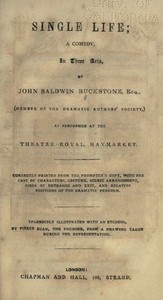
Single Life: A Comedy, in Three Acts — A Reader’s Guide
23
9
Project Gutenberg
2014
Comedy plays; English drama -- 19th century
Readers of public-domain and historical texts
Project Gutenberg digital edition
en
Edition facts
Words: 26,089
Reading time: 114 min
Text sections: 7
Source:
Project Gutenberg record #46918
Buckstone's 1839 comedy uses a three-act structure and shifting domestic settings to expose the social performances of bachelors and spinsters, with recurring motifs of mirrors, gossip, and costume.
Editorial Edition Score
4.6/5
★★★★★
★★★★★
Calculated from edition completeness, EPUB availability, text structure and catalogue metadata. Not a user rating.
Edition quality
John Baldwin Buckstone's Single Life: A Comedy, in Three Acts (1839) moves through a series of carefully contrasted interiors—from Mr. Niggle's apartment to a neat cottage, an inn parlour, and Miss Snare's rooms—each setting framing a different phase of the battle between the sexes. The play's structure, with its seven scenes across three acts, mirrors the characters' fluctuating resolves: bachelors vow to remain single, spinsters scheme to entrap them, and both parties perform exaggerated versions of themselves. Costume descriptions in the dramatis personae—Pinkey's pink accessories, Boss's chocolate-coloured Newmarket coat with roses—signal that identity is a matter of surface display.
Mirrors and Self-Regard
The stage directions repeatedly place characters before mirrors, literalizing the theme of self-absorption. Narcissus Boss, true to his name, “rises and looks at himself in the glass” during a heated exchange, more interested in his reflection than the argument. This gesture recurs: Boss's vanity is a running visual joke, but it also points to a broader pattern. The bachelors are defined by their costumes—Pinkey's lavender coat and pink watch ribbon, Damper's old-fashioned wig—and the play invites the audience to see these as deliberate performances. When Miss Coy accuses others of spreading gossip, she is herself performing injured innocence. The mirror becomes a prop that underscores how each character curates a public image, even as private motives remain hidden.
Gossip as Plot Engine
Rumour and slander drive the action forward. Characters refer to the “Weekly Tell-tale,” a newspaper that has printed damaging stories about Miss Macaw and Miss Coy. The dialogue is thick with accusations: Miss Coy is called “a female adventurer” who “loiters in shady lanes” pretending to study botany; Miss Macaw is labelled a “run-away Opera dancer” and “insolvent boarding-house keeper.” These charges are never verified within the excerpts—the play withholds proof—but they function as catalysts for confrontation. Pinkey, the bashful bachelor, suddenly finds his voice to denounce Miss Coy, claiming Chester is her clandestine son. The comedy lies in the speed with which characters adopt and weaponise hearsay, and in the way gossip reshapes alliances from scene to scene.
Movement Between Public and Private Spaces
The play's geography traces a retreat from formal interiors to more intimate ones. Act I opens in Mr. Niggle's apartment, a bachelor's domain; Act II shifts to a cottage and then to Miss Snare's rooms, spaces coded as feminine. The final act returns to the cottage, moves to an inn parlour, and ends in an “elegant apartment at the manor-house.” This progression suggests a movement from masculine independence toward domestic entanglement, but the excerpts show that even private spaces are sites of public performance. In the cottage, characters continue to trade insults and revelations. The inn parlour, a neutral ground, becomes another arena for confrontation. Buckstone uses these transitions to keep the pace brisk and to prevent any single location from becoming a refuge from social scrutiny.
Theatricality of Costume and Gesture
The printed text includes detailed costume notes and stage business, reflecting the play's origin as a Haymarket production. Pinkey's “pink silk neckerchief, pink gloves, pink watch ribbon” make him a walking punchline; Boss's “roses in the buttonhole” and “hair dressed in the first style of elegance” mark him as a dandy. These visual cues are not mere decoration—they carry plot information. When Miss Coy “falls into her chair” after Pinkey's accusation, the gesture is as telling as her words. The play's comedy depends on the audience reading these signals: a kiss blown to Boss, a look in the mirror, a rising from a seat. Buckstone wrote for a theatregoer trained to interpret posture and prop, and the text preserves that layer of meaning.
Readers encountering Single Life as a text rather than a performance should attend to the stage directions and costume lists, which carry much of the satirical weight. The play rewards attention to who stands, who sits, and who looks at whom—or at themselves. Its three-act structure, with scenes that alternate between male and female domains, creates a rhythm of accusation and retreat. Buckstone leaves many mysteries unresolved in the excerpts: Chester's identity, the truth of the gossip, the fate of the couples. The comedy lies not in resolution but in the spectacle of social maneuvering.
Reader reflection
How will you remember this book?
Save your reaction, strongest insight, and memorable passage.
Your progress
0
/
10
2
How much did you enjoy the reading experience?
3
How likely are you to recommend this book?
4
How much effort did this book require?
5
Could you follow the author’s main argument?
6
Did this book create an emotional response?
7
Did the story or argument move comfortably?
8
How original did the book feel?
9
Which lesson or insight stayed with you?
10