1

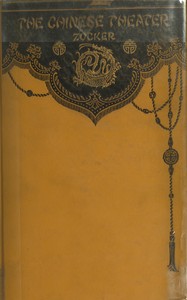
The Chinese theater — A Reader’s Guide
24
10
Project Gutenberg
2022
Theater -- China; Chinese drama -- History and criticism
Readers of public-domain and historical texts
Project Gutenberg digital edition
en
Edition facts
Words: 64,999
Reading time: 283 min
Text sections: 18
Source:
Project Gutenberg record #69475
A. E. Zucker's 1925 study of Chinese theater combines historical survey, translated play excerpts, and firsthand observations from Peking, focusing on performance conventions, social context, and the gap between literary drama and stage practice.
Editorial Edition Score
4.8/5
★★★★★
★★★★★
Calculated from edition completeness, EPUB availability, text structure and catalogue metadata. Not a user rating.
Edition quality
Zucker opens his study with a telling anecdote: a Western traveler, offered evening theatricals at an inn, flees to avoid 'sounding brass and clanging cymbal.' This image of cultural dissonance frames the book's central argument—that Chinese theater, though often dismissed as crude by outsiders, demands a different kind of attention. Zucker, a professor of comparative literature who spent five years in Peking, positions himself as a mediator between traditions, acknowledging that Chinese drama 'stands on a relatively lower level than some other Chinese arts' while insisting that the actor's skill is no less than his Occidental colleague's.
The work is structured as both a history and a field report. Zucker notes that no comprehensive history of Chinese drama existed at the time, partly because Chinese scholars themselves did not treat drama as literature. His book attempts to gather scattered knowledge, supplementing it with his own experience of the Peking stage and a modest command of the local dialect.
A Scholar's Double Perspective
Zucker writes from a hybrid position: he is an academic trained in comparative literature, yet his authority comes from five years of watching plays in Peking, not from archival mastery. He admits that 'the information we possess on this vast subject is very meager,' and that much of it is out of print. This candor shapes the book's voice—neither a definitive encyclopedia nor a travelogue, but a provisional synthesis. The preface reveals a tension between Western expectations and Chinese practice: the drama may be 'poor' as literature, but the actor 'holds the mirror up to life' with consummate skill. Zucker's own language shifts between scholarly distance and personal observation, as when he describes the 'sounding brass and clanging cymbal' that so repelled the tired traveler. This dual register—analytical yet grounded in sensory detail—gives the book its particular texture.
The Play Excerpt as Evidence
The included play fragment, a domestic dispute over a daughter's marriage, illustrates how Zucker uses translated scenes to support his arguments. The dialogue is brisk and colloquial: Mr. Tien scoffs at his wife's reliance on a 'Divine Stick' and fortune-tellers, declaring, 'You have no confidence in your own eyes, so you go and put complete confidence in those who have no eyes at all!' The scene turns on a conflict between superstition and rationalism, but Zucker undercuts any simple reading by having Mr. Tien himself forbid the match—not because of the gods, but because the families share the same surname, violating ancestral law. This twist reveals the layered social codes that govern Chinese life, a point Zucker likely develops in his analysis. The excerpt is not presented as a literary masterpiece but as evidence of cultural logic in action.
Pace and the Problem of Completeness
The book's structure is uneven: it moves from historical overview to translated play to technical discussion of staging, but the excerpts provided are fragmentary. The marriage scene breaks off mid-argument, and the surrounding text is missing. This incompleteness is not a flaw but a feature of Zucker's method—he is assembling a mosaic from available sources, acknowledging gaps. The pacing shifts between dense historical exposition and lively dramatic dialogue, mirroring the contrast between Chinese drama's literary reputation and its vibrant performance tradition. Readers should expect a work that prioritizes breadth over depth, offering a starting point rather than a final word. Zucker's own voice, alternately professorial and anecdotal, guides the reader through this terrain, making the book feel like a lecture from a knowledgeable but self-aware guide.
Zucker's book is best approached as a period document—a Western scholar's earnest attempt to make Chinese theater legible to an English-speaking audience in 1925. Its value lies less in definitive claims than in the questions it raises: How do we judge a performance tradition when the scripts seem thin? What counts as evidence when the practitioners themselves have not written a history? Readers interested in cross-cultural encounters, early sinology, or the history of theater studies will find this a rich, if partial, source.
Reader reflection
What did you think of this book?
Answer a few questions and save a private reflection on this device.
Your progress
0
/
10
2
How did the book work for you overall?
3
Would you recommend this book to another reader?
4
How much effort did this book require?
5
Did the book deliver what you hoped for?
6
Was the book easy to understand?
7
Did the book offer a fresh perspective?
8
Would this book work well in a reading group?
9
In one sentence, what did you learn?
10