1

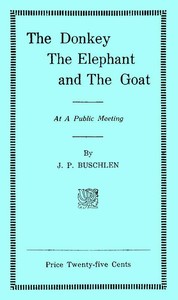
The Donkey, the Elephant, and the Goat at a Public Meeting — Edition Insights
23
10
Project Gutenberg
2016
Political plays; United States -- Politics and government -- 20th century -- Drama
Readers of public-domain and historical texts
Project Gutenberg digital edition
en
Edition facts
Words: 5,511
Reading time: 24 min
Text sections: 2
Source:
Project Gutenberg record #51473
Jack Preston's 1920 political playlet uses a donkey, elephant, and goat to satirize U.S. party politics through rhyming verse, with the goat representing the emerging Farmers' and Workers' party.
Editorial Edition Score
4.3/5
★★★★★
★★★★★
Calculated from edition completeness, EPUB availability, text structure and catalogue metadata. Not a user rating.
Edition quality
Jack Preston's 1920 playlet The Donkey, the Elephant, and the Goat at a Public Meeting opens with a pointed announcement: the author claims poetic license to treat the goat as an emblem of the Farmers' and Workers' political party, acknowledging this is 'not as yet quite a fact, nationally.' The work is a verse drama, written in simple rhyme, where three animal figures—the Democratic donkey, Republican elephant, and a goat representing a third-party movement—trade insults and arguments on a public stage. The dialogue is brisk and combative, with each character's speech revealing its political posture through diction and rhythm.
Rhymed Insults as Political Argument
The playlet's verse form is central to its satirical effect. The elephant speaks in grand, self-aggrandizing couplets: 'I made this land a world of homes—' only to be undercut by the goat's interjection: 'And laws with strange contortions.' The donkey, meanwhile, adopts a mock-polite tone—'If I may but inject a word'—before delivering a barb. The rhyme scheme (ABAB) gives the exchanges a singsong quality that undercuts the characters' pomposity, turning political debate into a nursery-rhyme squabble. Preston's choice of meter and rhyme forces the reader to hear the arguments as both earnest and absurd, a duality that reinforces the play's critique of partisan rhetoric.
Animal Symbolism and Party Identity
Each animal's traits are exaggerated to lampoon its party's perceived characteristics. The elephant boasts of its 'mighty' stature and claims a legacy of service: 'I packed my grip and trumpeted / The news of my arrival.' The donkey counters with accusations of 'cant' and 'flighty' behavior, positioning itself as 'a donkey wise, / With pedigree unlowly.' The goat, the newest and least established figure, presents itself humbly: 'I'm glad I'm but a simple goat / With humble beard and frocking.' This self-deprecation contrasts with the established parties' grandiosity, suggesting the third party's appeal lies in its rejection of pomp. The author's note explicitly states the goat is not yet a national emblem, grounding the symbolism in contemporary 1920 politics.
The Author's Staging Instructions and Intent
Preston's announcement reveals the playlet's dual purpose: it is both a political tool and a fundraising vehicle. He grants free performance rights to those 'assisting the farm and labor movement,' while requiring payment for money-raising events. This framing positions the text as activist theater, meant to be performed, not just read. The setting—a public meeting—and the direct address to 'dear folks' in the elephant's speech ('Since you, dear folks, have been so weak / As to invite such preachers') create a sense of immediacy and audience involvement. The author's location in Great Falls, Montana, and the 1920 date tie the work to the post-World War I agrarian and labor unrest in the American West.
Diction as a Window into Character
The characters' word choices reveal their rhetorical strategies. The elephant uses grandiose, biblical language ('a great revival') and name-drops P. T. Barnum to claim authority. The donkey favors legalistic, condescending terms ('plebe'an,' 'interpose') and frames itself as rational. The goat's speech is plain and self-deprecating, but it delivers sharp retorts: 'A mule is always mean.' The donkey's insult—'His boastful manner ill becomes / A thing of such proportions'—mocks the elephant's size, while the elephant dismisses the donkey's 'sleepy eyes / And manner smooth and holy.' These verbal jabs rely on physical and behavioral stereotypes, making the political critique visceral and personal. The verse form amplifies the sting, as each rhyme lands like a punchline.
Readers approaching this playlet should attend to its performance context: the words are designed to be spoken aloud, with rhythm and rhyme driving the satire. The goat's role as an upstart emblem invites consideration of how third-party movements are portrayed in political literature. Preston's work is a period piece, rooted in 1920s farm-labor politics, but its technique of using animal allegory for partisan critique remains recognizable. The brevity of the text (5,511 words) makes it a quick but layered read, best appreciated with an ear for its verse and an eye for its historical moment.
Reader reflection
How did this book work for you?
Your answers remain private and are stored only in this browser.
Your progress
0
/
10
2
Did this book hold your interest?
3
Would you pass this book on to a friend?
4
How demanding did the text feel?
5
Did anything about the book feel genuinely new?
6
How did the pace of the book feel?
7
Did you gain anything practical from the text?
8
Which part made the strongest impression?
9
What did this book teach you most?
10