1

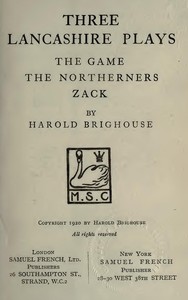
Three Lancashire Plays: The Game; The Northerners; Zack — Inside the Classic
29
11
Project Gutenberg
2017
English drama -- 20th century; Political plays; Lancashire (England) -- Drama
Readers of public-domain and historical texts
Project Gutenberg digital edition
en
Edition facts
Words: 71,121
Reading time: 310 min
Text sections: 10
Source:
Project Gutenberg record #55286
Harold Brighouse's 1920 collection of three plays set in Lancashire, blending political drama with regional dialect. The excerpts reveal factory disputes, machine-breaking threats, and a preface defending play-reading as imaginative collaboration.
Editorial Edition Score
4.8/5
★★★★★
★★★★★
Calculated from edition completeness, EPUB availability, text structure and catalogue metadata. Not a user rating.
Edition quality
Harold Brighouse’s preface to Three Lancashire Plays argues that printed plays, like architects’ plans, require imaginative effort from readers to become fully realized. He contrasts this with the limitations of stage production, where “producers are tedious pedants.” The collection itself—The Game, The Northerners, and Zack—offers three distinct dramatic treatments of Lancashire life, though only excerpts from The Game are included here. In that play, factory owner Ephraim Barlow faces a delegation of weavers who complain of starvation, low wages, and the displacement of hand-looms by machines. The dialogue is sharp and confrontational, with characters like Martin and Matthew voicing grievances in blunt Lancashire speech: “We’ve no time for patience. We’re famishing.”
The Preface as a Reader’s Manifesto
Brighouse opens his preface by noting that play-books were once a favored form of light reading, but the novel has since overtaken them. He insists that plays are written to be acted, yet the printed script is analogous to an architect’s plan—intelligible to a layman with “a trifling mental effort.” He warns that spectacular plays make poor reading, as their scripts become mere librettos for specific staging. Instead, he champions the reader who “mentally producing a play from the book in his hand looks through a magic casement.” This defense of imaginative reading is itself a kind of dramatic gesture, positioning the reader as co-creator. The preface also reveals Brighouse’s awareness of his medium: he acknowledges that plays of action do not make the best reading material, implicitly steering readers toward dialogue-driven works like his own.
Factory Floors and Frayed Tempers in <em>The Game</em>
The excerpt from The Game presents a tense negotiation between mill owners and weavers. Ephraim Barlow, the senior owner, tries to maintain control while his partner Guy Barlow offers patronizing assurances: “A great system is springing into birth. It isn’t perfect yet.” The weavers reject this, with Martin countering that the system has already forced them into factories “by the compulsion of need.” The dialogue is peppered with regional idioms—Matthew imagines St. Peter greeting a dead weaver with “Poor devil, get into heaven, you’ve had your bellyful of hell on earth.” Guy’s habit of drawing caricatures of the men during the confrontation underscores the power imbalance. The scene captures the early industrial era’s labor conflicts, with threats of machine-breaking and factory burning voiced openly.
Catalog Subjects vs. Dramatic Evidence
The catalog lists Three Lancashire Plays under “Political plays” and “Lancashire (England) — Drama,” which the excerpts support: the weavers’ delegation is explicitly political, demanding higher wages and fewer machines. However, the “Historical, Psychological & Social Fiction” category is only partially borne out. The excerpt is historical in setting (post-war, with references to a recent war and the rise of factories) and social in focus, but psychological depth is limited—characters speak as representatives of their class rather than as individuals. The preface, meanwhile, is neither political nor psychological; it is a meta-theatrical argument about reading. Readers should note that the catalog’s “Political plays” label fits The Game’s excerpt, but the other two plays in the collection may diverge. The excerpts do not reveal whether The Northerners or Zack continue the political theme or explore different aspects of Lancashire life.
Readers approaching Three Lancashire Plays will find that Brighouse’s preface sets a specific expectation: these are scripts meant to be staged in the mind. The excerpt from The Game rewards that approach with vivid, confrontational dialogue and a clear sense of place. The other two plays are not sampled here, so their tone and subject remain unknown. Treat the catalog’s political label as a starting point, not a summary.
Reader reflection
How did this book work for you?
Your answers remain private and are stored only in this browser.
Your progress
0
/
10
2
How did the book work for you overall?
3
Would you recommend this book to another reader?
4
What was the reading difficulty like?
5
Do you expect to return to this book?
6
How did the reading compare with what you expected?
7
How personally connected did you feel to the book?
8
How much did the book move you?
9
What changed or sharpened your thinking?
10