1

Woodcock's Little Game: A Comedy-Farce, In Two Acts — Reading Companion
30
18
Project Gutenberg
2018
Comedy plays; English drama -- 19th century
Readers of public-domain and historical texts
Project Gutenberg digital edition
en
Edition facts
Words: 17,188
Reading time: 75 min
Text sections: 5
Source:
Project Gutenberg record #57451
John Maddison Morton's 1864 comedy-farce follows newlywed Mr. Woodcock's frantic attempts to control his wife's dancing partners through clock-tampering and other schemes, with rapid-fire dialogue and physical comedy.
Editorial Edition Score
4.5/5
★★★★★
★★★★★
Calculated from edition completeness, EPUB availability, text structure and catalogue metadata. Not a user rating.
Edition quality
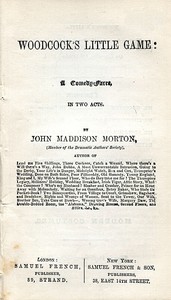
John Maddison Morton's Woodcock's Little Game opens with a servant, David, writing a letter that comically inflates the local population upon his master's arrival. This small detail signals the play's fondness for absurd arithmetic and verbal play. The farce, first performed in 1864, relies on a tight structure of misunderstandings and physical gags, as the title character attempts to manipulate time itself to keep his new wife from dancing with other men.
Clockwork Comedy
The play's central mechanism is a literal clock. Woodcock, anxious about his wife dancing with Mr. Larkings, jumps onto a chair and advances the clock by an hour. He then pretends to discover that his watch is slow, creating a cascade of conflicting timepieces. This gag recurs when Larkings and other gentlemen produce their watches, each showing a different time. Morton uses the clock not just as a prop but as a structural device: the entire second act hinges on whether Woodcock's tampering will be discovered. The stage directions emphasize the clock's prominence, placed in a "conspicuous part of the stage," ensuring the audience never loses sight of the deception.
Diction of Deception
Morton's dialogue is packed with verbal tics that reveal character. Woodcock's speech is full of nervous repetition and self-correction: "I will presently—there's plenty of time! It's quite early yet!" He also indulges in malapropisms, such as "I'll have a shy at the sausages—I mean Schottisches!" This slip between a food item and a dance highlights his distracted state. Swansdown, by contrast, speaks in short, explosive bursts: "Yes! ha, ha, ha!" and "Listen!" His dialogue is punctuated by grimaces and forced laughter, as described in the stage directions. The servant David uses a rustic dialect, referring to "master" and "me," and his letters are filled with numerical obsessions—population counts, wedding statistics—that mirror Woodcock's own fixation on counting time.
Staging the Farce
The stage directions reveal a carefully choreographed physical comedy. Woodcock's actions are described in precise sequence: he "lounges up stage, assuming an unconcerned manner and humming a tune—when near the clock, looks right and left, then jumps up into a chair, puts the clock on one hour, and jumps off chair again." The farce also relies on entrances and exits timed to music. The polka music swells at key moments, and characters dance in and out of doors, creating a whirlwind of activity. At one point, Woodcock dashes opera cloaks onto the sofa and throws himself upon them, burying his head in a pillow. These physical gags are integral to the plot, not mere interludes.
Marriage and Mistrust
Beneath the comedy, the play explores marital jealousy. Woodcock's scheme to control his wife's movements by altering the clock is a literal attempt to manage time itself. His wife, Mrs. Woodcock, is initially unaware of his manipulations, but her line "How the time slips away!" carries ironic weight. The other married couples—Larkings and his wife, Mrs. Colonel Carver—are similarly entangled in suspicions. Swansdown's frantic return, pale and excited, suggests that Woodcock's "little game" has consequences beyond the ballroom. The play does not resolve these tensions; instead, it leaves Woodcock buried in cloaks, having failed to escape the evening's complications.
Readers approaching Woodcock's Little Game should attend to the interplay between spoken dialogue and stage business. Morton's farce rewards attention to timing—both the literal clockwork and the pacing of entrances, exits, and musical cues. The play's humor depends on the audience's awareness of what characters do not know, making it a study in dramatic irony as much as a light entertainment.
Reader reflection
Your personal reading reflection
Build a private reading journal entry for this title.
Your progress
0
/
10
2
How did the book work for you overall?
3
Would you pass this book on to a friend?
4
Did the language feel accessible?
5
How strong was your personal connection to the text?
6
Did you gain anything practical from the text?
7
Which aspect of the book did you value most?
8
Did the book meet your expectations?
9
Which lesson or insight stayed with you?
10