1

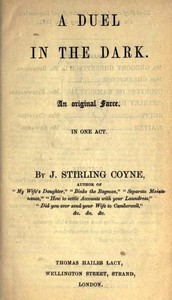
A Duel in the Dark: An Original Farce, in One Act — Themes and Context
(0 User reviews)
1894
Project Gutenberg
2015
Not confirmed
Comedy plays; English drama -- 19th century
Readers of public-domain and historical texts
Project Gutenberg digital edition
en
Edition facts
Words
11,456
Reading time
50 min
Text sections
4
The catalog record for A Duel in the Dark: An Original Farce, in One Act — Themes and Context provides practical reading context through 11,456 words, 50 min estimated reading time, and 4 detected text sections.
The text analysis averages about 13.4 words per sentence, while the detected sections provide another way to judge how the source is divided.
Project Gutenberg metadata also associates the work with “Comedy plays,” connecting these edition facts with the source record’s subject description.
Source:
Project Gutenberg record #50012
Coyne's one-act farce relies on rapid-fire dialogue, mistaken identity, and a literal duel in darkness. The play's comic tension emerges from verbal confusion and physical comedy, with characters' voices shifting between panic and bravado.
Editorial Edition Score
4.5/5
★★★★★
★★★★★
Calculated from edition completeness, EPUB availability, text structure and catalogue metadata. Not a user rating.
How this score is calculated
- Description quality20 pts
- Title & short description10 pts
- Source metadata20 pts
- Text length15 pts
- Chapters / structure15 pts
- EPUB file integrity20 pts
Total of 100 points, scaled to a 2.5-5.0 range. Editions with an empty description or a missing EPUB file are not scored.
Edition quality
Read the complete public-domain text at its original source.
Read on Project GutenbergJ. Stirling Coyne's A Duel in the Dark opens with Gregory Greenfinch carrying a bandbox, cloak, carpet bag, and umbrella into a hotel room at Dieppe, immediately establishing a tone of domestic absurdity. His first speech, comparing himself to "a tangled penn'orth of thread," signals the play's reliance on verbal confusion and physical comedy. The farce, first performed at the Theatre Royal Haymarket in 1852, unfolds in a single act of about fifty minutes, with the action confined to one handsomely furnished apartment. Coyne wastes no time in setting up the central predicament: Greenfinch has traveled from Paris with a Countess he has never seen, and his wife has arrived to complicate matters.
Verbal Tangles and Identity Confusion
Greenfinch's opening monologue establishes a voice that is both self-important and flustered. He describes himself as "like a tangled penn'orth of thread" and later, when confronted by his wife, spirals into a grammatical knot: "What if he should be me, and me he—no, he me, and me he—no, that's not it—what, if I'm he—and me—I mean if I—that's me—no—he and I are neither he nor me." This rapid, fractured syntax mirrors the plot's central confusion over identity. Mrs. Greenfinch, disguised as her husband, matches his bluster with deadpan threats: "I shall dispose of you immediately—my pistols are in the next room." The dialogue moves at a breathless pace, with characters interrupting themselves and each other, creating a rhythm that propels the farce forward.
The Mechanics of a Darkened Stage
The duel itself is a masterclass in stagecraft. Greenfinch insists on fighting in the dark, and Coyne uses the blackout for comic effect: Greenfinch gropes for his pistol, starts back when he touches it, and complains that "the touch of them throws me into a cold perspiration." The stage directions specify that the windows are shut, curtains drawn, and candles blown out, leaving the audience to rely on sound and the actors' movements. Mrs. Greenfinch, meanwhile, has loaded the pistols with powder only, a detail revealed in an aside to her maid Betsy. This knowledge creates dramatic irony: the audience knows the duel is harmless, while Greenfinch's terror is genuine. The physical comedy of two people stumbling in the dark, one terrified and one calmly threatening, drives the humor.
Pace and Structure in a One-Act Farce
Coyne compresses the entire plot into a single act of about 11,500 words, with no scene changes. The pace is relentless: Greenfinch's entrance is immediately followed by his wife's arrival, and the duel is proposed within minutes. The play's structure relies on a series of escalating misunderstandings, each resolved by a new twist. The language shifts between Greenfinch's panicked asides and Mrs. Greenfinch's cool, almost professional threats. The farce's brevity means that every line serves either to advance the plot or to heighten the comic tension. Coyne's experience as a prolific playwright of farces and comedies is evident in the tight construction, where even the stage properties—bandbox, cloak, pistols—are used for comic effect.
Readers approaching A Duel in the Dark should attend to the rhythm of the dialogue and the physical comedy embedded in the stage directions. Coyne's farce rewards attention to verbal detail: the characters' speech patterns reveal their panic, confidence, or confusion. The play is best read aloud, as the humor depends on timing and inflection. The single-act structure means that every line counts, and the dark stage at the climax invites the reader to imagine the chaos of unseen movement.
Reading A Duel in the Dark, I remembered late nights in my aunt’s parlor, where chaos felt safe because it was scripted. That same warmth—voices tangled, then unwound—came back when I first held Drawing Rooms, Second Floor, and Attics: A Farce, in One Act — Text and Context. Something about doors opening into wrong rooms, and laughter covering the fear.
There are no reviews for this eBook.
There are no comments for this eBook.
Reader reflection
Your personal reading reflection
Build a private reading journal entry for this title.
Your progress
0
/
10
2
How did the book work for you overall?
3
Is this a title you would suggest to others?
4
What was the reading difficulty like?
5
How strong was your personal connection to the text?
6
What was the strongest part of the book?
7
Did anything about the book feel genuinely new?
8
Do you expect to return to this book?
9
In one sentence, what did you learn?
10