
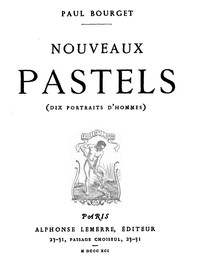
Nouveaux Pastels (Dix portraits d'hommes) by Paul Bourget
Paul Bourget’s Nouveaux Pastels is a fascinating snapshot of a bygone era, packaged as ten distinct character studies. Originally published in 1891, it belongs to a tradition of French psychological realism, where understanding a person’s inner world is the whole point of the story.
The Story
There isn't one single plot. Instead, the book is a gallery. Each chapter introduces us to a different man from French society—we meet an aging painter, a conflicted politician, a skeptical scientist, a heartbroken lover, and others. Bourget doesn't give us their entire life story. Instead, he focuses on a defining moment, a crucial flaw, or a secret obsession. We see the painter confronted by a younger, more brilliant rival, facing the ghost of his own former ambition. We follow the politician as a long-buried scandal threatens to surface. The drama is almost entirely internal, played out in their thoughts, regrets, and quiet dilemmas.
Why You Should Read It
I was pulled in by Bourget’s sharp eye for detail. He has a way of pinpointing the exact thought that keeps a man awake at night. Reading this feels less like reading fiction and more like being a perceptive observer at a dinner party, catching the subtle signs of worry or pride on a guest's face. The book is a time capsule of late-19th-century anxieties about art, faith, love, and public reputation. But here’s the thing: the emotions feel timeless. That fear of being irrelevant? The weight of a bad decision? The gap between who we are and who we pretend to be? These portraits, though dressed in waistcoats and speaking of duels, are about struggles we still recognize.
Final Verdict
This isn't a book for someone craving fast-paced action. It’s for the patient reader who loves diving deep into character. Think of it as the literary equivalent of studying a detailed portrait painting—you have to look closely to appreciate the skill and the story it tells. It’s perfect for fans of classic European literature, anyone interested in the history of psychology, or readers who simply enjoy beautifully crafted, introspective prose. If you liked the character-focused moments in writers like Henry James or Edith Wharton, you’ll find a similar, if more concentrated, pleasure here.
This historical work is free of copyright protections. Knowledge should be free and accessible.
James Lopez
2 years agoThis is one of those stories where the pacing is just right, keeping you engaged. Thanks for sharing this review.
Richard Sanchez
9 months agoI came across this while browsing and it manages to explain difficult concepts in plain English. Absolutely essential reading.
Amanda Miller
5 months agoAmazing book.
Kimberly Young
1 year agoMy professor recommended this, and I see why.


Donna Hill
1 year agoAs someone who reads a lot, the character development leaves a lasting impact. I learned so much from this.