1

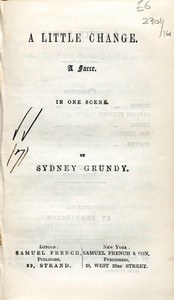
A Little Change: A Farce in One Scene — Reading Companion
19
9
Project Gutenberg
2014
Comedy plays; English drama -- 19th century
Readers of public-domain and historical texts
Project Gutenberg digital edition
en
Edition facts
Words: 10,308
Reading time: 45 min
Text sections: 2
Source:
Project Gutenberg record #46044
Sydney Grundy's one-act farce uses rapid-fire dialogue and escalating misunderstandings to explore marital boredom and flirtation. The play's single scene and tight structure rely on precise comic timing and verbal repetition, with characters' complaints about scenery and music mirroring their restless relationships.
Editorial Edition Score
4.5/5
★★★★★
★★★★★
Calculated from edition completeness, EPUB availability, text structure and catalogue metadata. Not a user rating.
Edition quality
Sydney Grundy's A Little Change opens with a newlywed husband yawning fifteen times in ten days of marriage—a detail his wife Ethel has counted to the minute. This farce in one scene wastes no time establishing its central tension: the gap between romantic expectation and domestic tedium. The dialogue moves at a brisk, quarrelsome pace, with Edwin's complaints about the "blazing agricultural suns" and "stupid old moon" serving as comic proxies for his deeper restlessness. Grundy's language is precise and economical; every line either advances the plot or sharpens a character's voice. The play's single setting—a hotel room overlooking the sea—becomes a pressure cooker for flirtation, jealousy, and mistaken identities, all orchestrated through a series of carefully timed entrances and exits.
Repetition as Comic Engine
Grundy builds much of the farce's humor on verbal repetition. Ethel asks Edwin whether he is tired of her twenty-two times in ten days; Edwin yawns on cue; the moon is called "the same old moon" twice in quick succession. These patterns are not mere filler—they establish a rhythm of marital friction that the plot then exploits. When Edwin declares "I like a little change," the phrase becomes a refrain, echoed by other characters as they each pursue their own diversions. The repetition also underscores the characters' entrapment: they keep saying the same things because they are stuck in the same situation. The playwright trusts the audience to catch the accumulating absurdity, allowing the humor to build without explanatory asides.
Sound and Silence in a Single Scene
The play's soundscape is unusually detailed for a one-act farce. An organ grinder, bagpipes, and a singing boy intrude at key moments, each triggering a negotiation over money and a shift in the characters' attention. Captain Plunger is forced to pay eighteenpence, then half-a-crown, to silence the musicians—a running gag that also reveals his growing financial discomfort. The interruptions serve as punctuation: they break up conversations, create awkward pauses, and provide cover for characters to slip on and off stage. Grundy uses these aural intrusions to control pacing, accelerating the action when the dialogue threatens to stall. The final sung line—"And the captain with his whiskers stole a sly glance at me"—neatly comments on the flirtation Edwin has just discovered.
Marriage as a Competitive Sport
When the two wives, Ethel and Mrs. Plunger, meet on the balcony, their reunion quickly turns into a contest over who married first and who flirted more before marriage. "I got mine first," Ethel says; Mrs. Plunger retorts that Ethel was "always in a hurry to get married." The dialogue is laced with barbed compliments and one-upmanship, suggesting that marriage itself is a performance for these characters. Grundy does not moralize—he simply lets the women trade insults with the same energy the men use to complain about the scenery. The farce's structure, with its symmetrical pairings (Edwin/Ethel, Captain/Mrs. Plunger), reinforces the idea that everyone is playing the same game, just with different partners.
Because the excerpts cover only the first half of the play, the resolution of the flirtations and misunderstandings remains unknown. Readers should pay attention to how Grundy resolves the parallel plots: whether the characters return to their original partners or swap, and whether the "little change" Edwin craves proves satisfying or disastrous. The play's title, repeated as a line by both Edwin and Ethel, may hint at a circular structure rather than a straightforward conclusion.
Reader reflection
How did this book work for you?
Your answers remain private and are stored only in this browser.
Your progress
0
/
10
2
How much did you enjoy the reading experience?
3
Would you recommend this book to another reader?
4
Did the language feel accessible?
5
What did you think about the pace?
6
Was the book easy to understand?
7
How valuable was this book for your own interests?
8
Did any part of the book feel personally relevant?
9
What changed or sharpened your thinking?
10