1

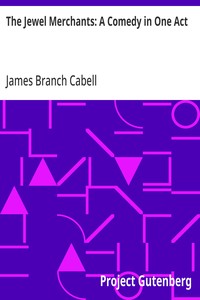
The Jewel Merchants: A Comedy in One Act — Themes and Context
27
9
Project Gutenberg
2006
Drama; Comedy plays
Readers of public-domain and historical texts
Project Gutenberg digital edition
en
Edition facts
Words: 12,210
Reading time: 54 min
Text sections: 2
Source:
Project Gutenberg record #9829
An editorial note on James Branch Cabell's one-act comedy, focusing on the author's collaborative revision process, the shift from literary dialogue to speakable lines, and the use of ironic reversals and historical setting in the excerpts.
Editorial Edition Score
4.5/5
★★★★★
★★★★★
Calculated from edition completeness, EPUB availability, text structure and catalogue metadata. Not a user rating.
Edition quality
James Branch Cabell's The Jewel Merchants began not as a play but as a short story, Balthazar's Daughter, and was transformed through a notably collaborative process. In his prologue, Cabell confesses that the initial version read well but did not 'act' at all, its dialogue 'unspeakable.' The published text, he explains, emerged from rehearsals where actors, the director, and the producing staff altered lines freely, substituting natural speech for his original 'rhetorical fripperies.' This genesis makes the play a document of practical stagecraft rather than a purely literary artifact.
From Unspeakable to Speakable
Cabell's prologue offers a rare, candid account of how a play's dialogue can be reshaped by performance. He describes how his manuscript was 'enriched with interlineations, to and beyond the verge of legibility' as actors delivered speeches 'having perfectly in mind the gist but not the phrasing.' The result was a collaborative text with 'almost as many contributing authors as though the production had been a musical comedy.' This process, he claims, eliminated 'not a shred' of his original literary language. The excerpts bear this out: the dialogue is crisp, colloquial, and driven by character rather than ornament. Graciosa's speech about Tebaldeo's execution, for instance, uses simple, repetitive structures ('I know that… I know that…') to build emotional force, a technique more suited to the stage than the page.
The Duke's Aesthetic Detachment
A striking stage direction in the excerpts reads: 'The DUKE is watching as if at a play. He is aesthetically pleased by the girl's anguish.' This moment crystallizes a key authorial choice: the Duke, a Medici ruler, observes Graciosa's emotional collapse with the detached appreciation of a spectator. The line aligns him with the audience, yet also distances him morally. Cabell uses this to underscore the cruelty of political power—the Duke is not merely a tyrant but a connoisseur of suffering. The direction is a small but precise tool, turning a potential melodrama into a study of cold spectatorship. It also reflects the play's own self-awareness as a theatrical construct, a quality Cabell hints at in his prologue when he notes the play's design for 'the little theatre stage.'
Reversals of Identity and Trust
The excerpts hinge on a series of revelations that invert the characters' relationships. Graciosa believes she is speaking to Guido, a friend, only to learn he is Count Eglamore, the man who ordered her cousin's execution. The Duke, initially a stranger, is revealed to have been spying on his own counselor. These reversals are not merely plot twists; they are embedded in the dialogue's structure. Graciosa's reaction—'So it was the hand of Eglamore… I thought it was the hand of my friend Guido'—emphasizes the betrayal of touch and trust. Cabell also uses the Duke's line, 'my twenty cut-throats are fetching back for me a brace of nuns,' to inject a darkly comic note that undercuts the gravity of the scene. The play's comedy, then, arises not from lightheartedness but from the ironic gap between characters' perceptions and the brutal realities of power.
The Weight of a Wren's Nest
Graciosa's memory of Tebaldeo fetching a wren's nest from a maple tree is the play's most potent image. It recurs in her accusation speech, anchoring her grief in a specific, domestic detail. The nest contrasts sharply with the cross on which Tebaldeo died, 'set upon a pivot, so that it turned slowly.' Cabell uses this juxtaposition to compress the play's emotional range: the innocent past and the horrific present collide in a single speech. The image also ties the garden setting—where the entire action takes place—to the memory of childhood play. This is not mere sentiment; it is a structural device that gives Graciosa's anger a concrete foundation. The wren's nest, like the handshake she later tries to 'clean,' becomes a symbol of violated intimacy. Cabell's choice to ground high emotion in such a small, tangible object is a mark of his theatrical craft.
Readers approaching The Jewel Merchants should attend to its stage directions, which often carry as much weight as the dialogue. The play's brevity—a single act—means every line and gesture is compressed. Cabell's prologue is not a mere preface but a key to understanding the text's collaborative origins. The comedy is sharp, the betrayals swift, and the historical setting of Medici Florence is used not for pageantry but as a lens on political manipulation. The play rewards attention to its small, telling details: a wren's nest, a pivot, a handshake that must be cleaned.
Reader reflection
What did you think of this book?
Answer a few questions and save a private reflection on this device.
Your progress
0
/
10
2
How much did you enjoy the reading experience?
3
Would you pass this book on to a friend?
4
How easy was the book to follow?
5
How understandable was the text?
6
What did you appreciate most?
7
How strongly did the book affect you emotionally?
8
What did you think about the pace?
9
What is the main idea you are taking away?
10