1

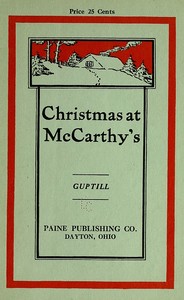
Christmas at McCarthy's — Reading Companion
20
10
Project Gutenberg
2017
Drama; Christmas plays
Readers of public-domain and historical texts
Project Gutenberg digital edition
en
Edition facts
Words: 12,060
Reading time: 53 min
Text sections: 2
Source:
Project Gutenberg record #53895
A Christmas play structured as a community talent show, where Irish, Swedish, Italian, and African American characters perform songs and recitations, revealing cultural accents and family reunions.
Editorial Edition Score
4.5/5
★★★★★
★★★★★
Calculated from edition completeness, EPUB availability, text structure and catalogue metadata. Not a user rating.
Edition quality
Christmas at McCarthy's is structured as a sequence of performances within a single evening, each introduced by the host Katie McCarthy. The play moves from one act to the next with minimal scene changes, relying on the variety of characters and their distinct voices to create momentum. The excerpts show a pattern: each performer is announced, delivers a piece (often a recitation or song), and receives a brief comment from the audience. This structure gives the work the feel of a community talent show, where the drama lies not in plot but in the interplay of accents, cultural references, and the audience's reactions.
A Chorus of Accents and Introductions
The play’s dialogue is built around heavily marked dialect, with each character’s speech signaling their ethnic background. Katie McCarthy uses Irish brogue (“Shure and it was thot same”), while Mr. Opperman speaks in German-inflected English (“Dot von goot ting to do vos, aretty”). Cleopatra, an African American character, uses vernacular (“’Twarn’t no resh’tashing”). These accents are not merely decorative; they are central to the humor and identity of each performer. The introductions themselves become mini-performances, as when Katie corrects Mickey’s announcement of Luigi’s fiddle playing, insisting on a more formal phrasing. The audience’s comments, like Pat’s recollection of hearing Bridget sing in Kerry, tie the present moment to a shared past, reinforcing the community’s roots.
Recitations and Songs as Narrative Threads
Each performance piece is a self-contained unit, but together they create a mosaic of themes: childhood, family, and cultural heritage. The recitations have titles like “Santa’s Mistake,” “The Birdie’s Tree,” and “Baby’s Shopping,” suggesting lighthearted, domestic subjects. Songs range from an old Latin hymn to a “darkey lullaby” and a Swedish reference to birds at Christmas. The play does not develop a single plot; instead, the emotional arc comes from the cumulative effect of these performances. The final carol and the sudden arrival of Elsie’s father, Mr. Strauss, introduce a surprise reunion, but this is a brief coda rather than a climax. The structure prioritizes variety over linear storytelling.
Movement Between Performers and Audience
The play constantly blurs the line between stage and audience. Characters comment on each other’s acts, as when Lars warns Luigi not to tease his sister after Bianca’s recitation. The audience within the play—Pat, Katie, and others—react with applause, jokes, or memories, making the fictional spectators part of the action. This creates a layered effect: the reader or real audience watches a group of people watching a show. The interruptions, like Jimmy insisting Katie sing, break the fourth wall and keep the energy lively. The movement is not physical but social, as the focus shifts from one performer to the next, with the host Katie maintaining order through her announcements.
Recurring Images of Gifts and Family
Several details recur across the excerpts: the Christmas tree, gifts, and family bonds. Elsie’s tree, obtained by Jimmy, becomes a symbol of generosity, and Mr. Strauss’s sudden wealth (inherited from an uncle) introduces a fairy-tale resolution. The rag doll produced by Mammy for Cleopatra’s lullaby is a handmade, humble object, contrasting with the later promise of a “big real tree.” These images of giving are understated but consistent. The play also emphasizes family origins: Bridget’s hymn recalls her Kerry past, and Pat’s courtship story ties the present to a romantic history. The structure of the evening—a series of gifts (performances) offered to the community—mirrors the Christmas theme of giving.
Readers approaching Christmas at McCarthy's should expect a script that functions as a template for a community event. The play’s strength lies in its variety and the distinct voices of its characters, not in a tight narrative. The excerpts suggest that the work is best appreciated as a performance piece, where dialect and audience interaction come alive. The sudden reunion of Elsie and her father feels tacked on, but it underscores the play’s interest in family ties. For those staging it, the songs and recitations offer flexibility; the structure allows for substitutions or additions, making it adaptable to different groups.
Reader reflection
How will you remember this book?
Save your reaction, strongest insight, and memorable passage.
Your progress
0
/
10
2
Did this book hold your interest?
3
How likely are you to recommend this book?
4
How easy was the book to follow?
5
What did you think about the pace?
6
Did it raise ideas you would like to talk about?
7
How original did the book feel?
8
How understandable was the text?
9
In one sentence, what did you learn?
10