1

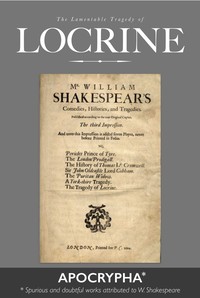
Locrine — Text and Context
27
8
Project Gutenberg
1998
Tragedies (Drama); Britons -- Drama
Readers of public-domain and historical texts
Project Gutenberg digital edition
en
Edition facts
Words: 20,306
Reading time: 89 min
Text sections: 8
Source:
Project Gutenberg record #1548
An editorial note on the pseudo-Shakespearean tragedy Locrine, examining how its catalog subjects (Tragedies, Britons) align with the play's actual content: a revenge-driven plot, classical allusions, and a clown subplot that complicates its generic identity.
Editorial Edition Score
4.6/5
★★★★★
★★★★★
Calculated from edition completeness, EPUB availability, text structure and catalogue metadata. Not a user rating.
Edition quality
The play attributed dubiously to Shakespeare opens not with a Briton but with the goddess Ate, who stages a dumb show of a lion killed by an archer before delivering a prologue in Latin. This framing device immediately signals a work more invested in allegorical revenge and classical machinery than in historical fidelity. The catalog subjects list 'Tragedies (Drama)' and 'Britons -- Drama,' but the excerpts reveal a text that borrows freely from Senecan tragedy, Ovidian myth, and medieval chronicle, often at the expense of coherent national history.
Revenge as Structural Engine
The excerpts show revenge driving the plot more consistently than any Briton-specific theme. Ate's prologue explicitly frames the action as punishment: 'In pœnam sectatur & umbra' (the shade pursues in punishment). Humber, the Scythian king, invokes 'you ugly sprites that in Cocitus mourn' and calls on 'fierce Erinnis' to torment Locrine. The ghost of Albanact appears twice, crying 'Revenge! revenge for blood!' and 'Vindicta, vindicta.' This relentless invocation of infernal powers—Cocytus, Lethe, Phlegethon, Tartarus—places the play firmly in the Senecan tradition, where vengeance is a cosmic imperative rather than a political one.
Classical Allusions Over British History
Despite the catalog subject 'Britons -- Drama,' the excerpts show the play reaching constantly for classical rather than native British reference points. Ate's second prologue compares Locrine to Hercules yielding to Omphale: 'Stout Hercules… Yielded his valiant heart to Omphale, / A fearful woman void of manly strength.' Humber wishes he had landed where 'Poliphemus and the Cyclops dwell' or where 'the bloody Anthrophagie / With greedy jaws devours.' The geography is Mediterranean, not British. Even the river Humber is explained through a classical lens: the stage direction specifies 'the river, afterward the Humber,' as if the name derives from the play's events rather than pre-existing geography.
The Clown Subplot and Generic Instability
The excerpts include a character named Strumbo, listed as 'a clown,' with a wife Dorothy and a man Trumpart. This comic presence—complete with rustic characters Oliver, William, and Margery—sits oddly alongside the high tragic rhetoric of Ate and the ghosts. The play's full title calls it 'The Lamentable Tragedy of Locrine,' yet the inclusion of a clown subplot suggests a hybrid form closer to the tragicomedies of the 1590s. The catalog subject 'Tragedies (Drama)' may therefore misrepresent the work's actual texture, which mixes Senecan revenge with broad comedy in a way that challenges simple generic classification.
Readers approaching Locrine expecting a straightforward British history play will find instead a curious amalgam: classical revenge tragedy, chronicle material, and clowning. The catalog subjects offer a starting point, but the excerpts reveal a work more interested in mythological allusion and Senecan fury than in coherent national narrative. Pay attention to the dumb shows and the role of Ate—they are the play's true structural spine.
Reader reflection
Before you leave, reflect on the book
Use these questions to collect your thoughts before moving on.
Your progress
0
/
10
2
How much did you enjoy the reading experience?
3
Would you recommend this book to another reader?
4
How much effort did this book require?
5
Did the book deliver what you hoped for?
6
Did the story or argument move comfortably?
7
Could you apply anything you learned?
8
How strong was your personal connection to the text?
9
Which lesson or insight stayed with you?
10