1

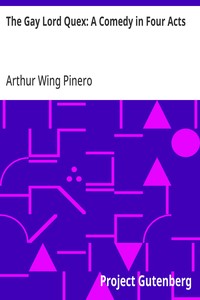
The Gay Lord Quex: A Comedy in Four Acts — A Reader’s Guide
23
8
Project Gutenberg
2005
Comedy plays; English drama -- 19th century
Readers of public-domain and historical texts
Project Gutenberg digital edition
en
Edition facts
Words: 34,319
Reading time: 150 min
Text sections: 8
Source:
Project Gutenberg record #15744
This editorial note examines how Arthur Wing Pinero's 1899 comedy uses its manicure salon setting, palmistry, and a locked-door scene to build suspense and character, guiding first-time readers through the play's structure.
Editorial Edition Score
4.6/5
★★★★★
★★★★★
Calculated from edition completeness, EPUB availability, text structure and catalogue metadata. Not a user rating.
Edition quality
Arthur Wing Pinero's The Gay Lord Quex opens not in a drawing-room but in a manicure establishment at 185 New Bond Street, a setting that immediately signals the play's interest in social transactions and personal grooming as performance. The stage directions are unusually precise: three french-windows, an ornamental partition with opaque glass, and a view of buildings on the east side of the street. This specificity roots the comedy in a tangible, modern London, while the partition—which blocks sight but not sound—foreshadows the eavesdropping and hidden motives that drive the plot. The play's four acts compress twenty-four hours, and the return to Bond Street in the final act suggests a structural symmetry that rewards attention to the opening scene's details.
The Manicure Salon as a Stage for Social Masks
The first act establishes Sophy Fullgarney's establishment as a space where class boundaries blur. The clientele includes the Duchess of Strood and Mrs. Jack Eden, yet they are served by manicurists whose names—Miss Moon, Miss Huddle, Miss Claridge—suggest a comic hierarchy. The dialogue reveals that Sophy is both a businesswoman and a confidante; the Duchess asks her about the palmist Valma, and Sophy responds with sharp, colloquial judgments: “if a woman is pretty, and Valma finds Venus's girdle well marked in her palm... it isn't much to suppose that there are a few horrid men licking their lips at the thought of her.” The Duchess is shocked by Sophy's “curious expressions,” but the exchange shows that the manicure room permits a frankness absent from polite society. Readers should note how the setting allows characters to speak across social ranks, creating a stage where secrets are both guarded and exposed.
Palmistry and the Language of Hands
Palmistry is not mere decoration; it functions as a plot device and a metaphor for reading character. The Duchess asks Sophy whether Valma truly has “the power of divination,” and Sophy affirms her belief. Later, the Duchess—alone—examines herself in a hand-mirror, smiles, and poses before a cheval-glass, suggesting that she is as concerned with her own appearance as with what others might see in her palm. The play's title character, Lord Quex, is known as “gay” in the older sense of pleasure-seeking, and the palmist's art implies that hidden desires can be read in the lines of the hand. For a first-time reader, the recurring references to hands—manicuring, palm-reading, even the tying of a ribbon to a door-handle—create a tactile motif that links physical touch to emotional manipulation. The excerpts do not reveal Valma's predictions, but the Duchess's eager questioning hints that she hopes for confirmation of her own attractiveness.
A Locked Door and a Single Champagne Glass
The third act, set in a boudoir and bedroom at Fauncey Court, contains a sequence of stage business that is both comic and tense. The Duchess, after dismissing Sophy, locks the door, tears a ribbon from her tea-gown using scissors, and ties it to the outer door-handle. She then produces a bottle of champagne and a single glass. The stage directions emphasize her deliberate movements: she “remains quite still for a moment, then rises promptly,” and after arranging her hair, she “smiles, frowns, and looks caressingly at herself.” The single glass is a striking detail—it suggests an anticipated visitor, yet the Duchess's preparations are solitary. Readers unfamiliar with the play may wonder whether she is setting a trap or preparing for a rendezvous. The locked door and the ribbon create a physical barrier that heightens the theatricality, and the champagne glass becomes a symbol of intimacy that may or may not be shared. This scene, excerpted without its resolution, exemplifies Pinero's skill at using props to generate suspense.
Structure and the Compression of Time
The play's action is “comprised within the space of twenty-four hours,” a classical unity that forces rapid character development and plot turns. The first act takes place in the afternoon, the second in the evening, the third at night, and the fourth the following day. This tight timeline means that every entrance and exit carries weight. The return to Bond Street in Act Four suggests a circular structure, but the excerpts do not reveal whether the characters have changed. The list of persons includes a Marquess, a Governor of Uumbos, a professional palmist, and a manicurist—a mix of aristocracy, colonial officialdom, and trade. The variety hints at a comedy of manners that crosses social strata. For a first reading, paying attention to who is present in each act and how the setting shifts from public salon to private garden to bedroom and back again can illuminate the play's commentary on performance and privacy. The excerpts offer no ending, but the careful staging of the third act's locked door promises a revelation that the final act must address.
Pinero's stage directions are unusually detailed, and readers who visualize the sets—the partition, the french-windows, the ribbon on the door-handle—will find that the comedy gains a physical dimension. The excerpts suggest that The Gay Lord Quex rewards attention to objects and gestures as much as to dialogue. As you read, note how the manicure salon's mirrors and the palmist's readings create a world where everyone is both observer and observed. The play's title character appears only in the list of persons; his entrance and his reputation as “gay” are left to the reader's anticipation.
Reader reflection
Before you leave, reflect on the book
Use these questions to collect your thoughts before moving on.
Your progress
0
/
10
2
How much did you enjoy the reading experience?
3
Would you pass this book on to a friend?
4
Did the language feel accessible?
5
Was the book moving at the right speed?
6
How well did it match your expectations?
7
Which element worked best for you?
8
Did any part of the book stay with you emotionally?
9
What did this book teach you most?
10