1

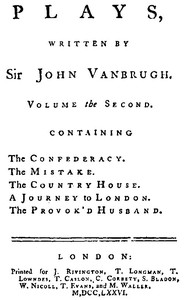
Plays, written by Sir John Vanbrugh, volume the second — Reading Companion
19
9
Project Gutenberg
2016
Comedy plays; English drama -- 18th century
Readers of public-domain and historical texts
Project Gutenberg digital edition
en
Edition facts
Words: 105,057
Reading time: 457 min
Text sections: 40
Source:
Project Gutenberg record #51114
This volume collects five comedies by Sir John Vanbrugh, including The Confederacy and The Provok'd Husband, featuring sharp dialogue, scheming servants, and satirical views of marriage and money in Restoration and early 18th-century London.
Editorial Edition Score
4.9/5
★★★★★
★★★★★
Calculated from edition completeness, EPUB availability, text structure and catalogue metadata. Not a user rating.
Edition quality
The prologue spoken by a "Shabby Poet" sets a self-mocking tone: the speaker complains of poverty, ragged clothes, and a brother whose "decent plays" have earned him a laurel crown but little else. This meta-theatrical jab at the playwright's own trade recurs throughout the volume. In The Confederacy, the dramatis personae immediately signal a world of financial scheming: two rich money-scriveners named Gripe and Moneytrap, a gamester son, and a maid named Flippanta. The excerpts show that Vanbrugh's comedy depends on rapid, colloquial exchanges and characters defined by their appetites—for money, status, or pleasure.
Money and Marriage as Paired Games
The catalog subjects list this as comedy and 18th-century English drama, but the excerpts reveal a specific preoccupation: the transactional nature of marriage. In The Confederacy, Clarissa is described as an "expensive luxurious woman" who will "run in debt to all the shopkeepers" and lose money at cards while her husband earns at Westminster. The play's title itself suggests a secret alliance, likely between wives or servants against husbands. Vanbrugh's characters treat matrimony as a financial arrangement to be exploited or endured. The Country House and A Journey to London continue this theme: in the latter, John Moody's comic report of a journey full of contradiction—"Slap goes one thing, crack goes another"—mirrors the chaos of a household where the lady's desires clash with the coach's limitations. The humor arises from the gap between characters' self-interest and the disorder it creates.
Dialect, Status, and the Servant's Voice
Vanbrugh gives servants distinctive speech patterns that mark both region and rank. John Moody in A Journey to London speaks in a thick Northern dialect: "I'm staut still, and a faithful awd servant to th' family." His repeated exclamations—"Gadswookers," "murrain upon all rogues and whores"—contrast with the more polished but equally scheming language of his masters. The maid Flippanta in The Confederacy has a name that hints at her flippant, quick-witted role. These characters are not mere foils; they drive the plot through their observations and actions. The prologue's "Shabby Poet" also occupies a liminal status, neither fully inside nor outside the theatrical world. By giving servants and marginal figures strong voices, Vanbrugh broadens the social range of his comedy beyond the usual Restoration elite.
Structure and Self-Reference in the Prologue
The prologue to this volume is unusual: it is spoken by a "Shabby Poet" who explicitly discusses the playwright's career. He mentions a brother who "writ for praise" and "meddling with some folks in black"—likely a reference to Vanbrugh's own clashes with the clergy over his earlier play The Relapse. The poet shows his ragged coat and laurel crown, complaining that the honor is worthless without means to eat. This self-referential opening frames the entire collection as the work of a writer aware of his precarious position in the literary marketplace. The prologue's structure—a series of complaints punctuated by gestures to the audience and the theater—mirrors the episodic, argument-driven style of the plays themselves. Readers encountering this volume should note how Vanbrugh uses the prologue to establish a tone of ironic self-deprecation that colors the comedies to follow.
Because the excerpts are drawn from multiple plays within the volume, readers should pay attention to how Vanbrugh varies his comic strategies: The Confederacy relies on intricate plotting among couples, while The Country House and A Journey to London lean on farcical arrivals and dialect humor. The Provok'd Husband, left unfinished by Vanbrugh and completed by Colley Cibber, may show a different hand. Approach each play as a distinct experiment in stage comedy, united by a skeptical view of human motives.
Reader reflection
What did you think of this book?
Answer a few questions and save a private reflection on this device.
Your progress
0
/
10
2
Was reading this book enjoyable?
3
How likely are you to recommend this book?
4
How easy was the book to follow?
5
Was the book moving at the right speed?
6
Did the book meet your expectations?
7
Did any part of the book stay with you emotionally?
8
Did the book offer a fresh perspective?
9
What did this book teach you most?
10