1

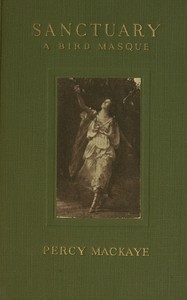
Sanctuary: A Bird Masque — Themes and Context
24
12
Project Gutenberg
2018
Birds -- Drama; Fairy plays
Readers of public-domain and historical texts
Project Gutenberg digital edition
en
Edition facts
Words: 10,948
Reading time: 48 min
Text sections: 8
Source:
Project Gutenberg record #56704
Percy MacKaye's verse drama for the dedication of a New Hampshire bird sanctuary, blending mythic figures with conservation advocacy. The excerpts show a masque where the hunter Stark is confronted by Ornis, a bird-spirit, and Tacita, a nymph of revelation, in a ritual of moral awakening.
Editorial Edition Score
4.6/5
★★★★★
★★★★★
Calculated from edition completeness, EPUB availability, text structure and catalogue metadata. Not a user rating.
Edition quality
Percy MacKaye's Sanctuary: A Bird Masque was written for the dedication of the Meriden Bird Club's sanctuary in New Hampshire, first performed on September 12, 1913. The text, composed and rehearsed within a month, reflects a collaborative effort among artists and nature lovers. The catalog subjects—'Birds -- Drama' and 'Fairy plays'—accurately signal the work's dual allegiance to ornithological advocacy and theatrical fantasy, but the excerpts reveal a more specific dramatic structure: a masque, not a straightforward play, with allegorical characters and ritualistic dance.
The Masque Form and Its Conservationist Purpose
The excerpts show that Sanctuary is a masque, a genre that blends poetry, music, dance, and spectacle. The foreword states it was written for a bird sanctuary dedication, and the note on performance insists that presentations must benefit wild bird conservation. This is not a generic fairy play; it is a piece of activist theater. The characters include Alwyn, Stark, Ornis, Tacita, Shy, and Quercus—names drawn from nature (Ornis means bird, Quercus is oak). The dance of Tacita, described as 'lulling, charming, luring' with 'numberless wing-swayings and bird-dartings,' is a central device for Stark's transformation. The masque thus uses allegory and spectacle to advance a specific environmental cause.
Stark's Transformation and the Role of Ornis
The excerpts trace a clear arc for Stark, the hunter. Initially, he is 'half-amused' and boasts of his hunting net. Alwyn calls him a 'murderer' who 'knows not he is such.' Tacita's dance leads him to a vision of 'wings, wings! swift wings, shy wings, eternal wings.' When he sees Ornis, he instinctively tries to capture her with his net, crying 'the shy bird shall be captured 'live!' But Ornis responds not with fear but with an appeal: 'Brother!—brother!' She recounts her ancient bond with humanity—'my cranes announced your victories, my storks fed your hearth-fires'—and chides him for selling her 'unto d...' (the excerpt cuts off). This confrontation, rather than a simple conversion, dramatizes a tension between domination and kinship.
The Poetic Voice and Its Debt to Chaucer
The epigraph from Chaucer—'Herkneth these blisful briddes how they singe'—signals a literary lineage. MacKaye's verse is formal and lyrical, with lines like 'O twilight—holy dusk—dawn twitterings!' and 'How far, how dim and hollow / You darkle over me.' The language is archaic in places ('Put off that blood-emblazed regalia'), and the characters speak in a heightened, poetic register. The excerpts do not reveal the full plot, but the verse style suggests a work meant for recitation and musical setting (Frederick S. Converse composed music for the lyrics). The masque's structure—with a prelude by Arvia MacKaye and photographs by Arnold Genthe—indicates a multimedia production, blending text, image, and performance.
Readers approaching Sanctuary should attend to its dual nature as both a literary text and a performance script. The excerpts offer only a portion of the masque, but they reveal a work that uses myth and poetry to advocate for bird conservation. The character of Ornis, part spirit and part victim, embodies the stakes of the drama. The masque's brevity (under 11,000 words) and its origin in a specific community event make it a document of early 20th-century environmental theater.
Reader reflection
How did this book work for you?
Your answers remain private and are stored only in this browser.
Your progress
0
/
10
2
Did this book hold your interest?
3
Would you encourage someone else to read it?
4
How demanding did the text feel?
5
How much did the book move you?
6
Would you read this book again?
7
What did you think about the pace?
8
Did the book give you something worth debating?
9
Which lesson or insight stayed with you?
10