1

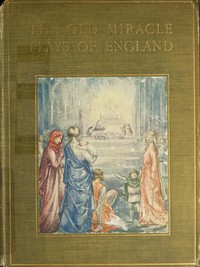
The Old Miracle Plays of England — Story, Setting & Ideas
32
12
Project Gutenberg
2021
Mysteries and miracle-plays, English; English drama -- To 1500
Readers of public-domain and historical texts
Project Gutenberg digital edition
en
Edition facts
Words: 30,447
Reading time: 133 min
Text sections: 5
Source:
Project Gutenberg record #65860
Netta Syrett frames medieval miracle plays within a story about two York children, Colin and Margery, who watch the Corpus Christi pageants. The narrative blends invented characters with actual play excerpts, including The Sacrifice of Isaac, where a messenger explains typology. Syrett's preface acknowledges liberties with historical accuracy.
Netta Syrett's The Old Miracle Plays of England (1911) introduces medieval religious drama through a fictional frame: two York children, Colin and Margery, attend the Corpus Christi pageants. The book's preface openly admits that Syrett has taken liberties—moving plays between cities and inventing stage directions—to create a coherent story for young readers. This hybrid approach means the text is neither a pure scholarly summary nor a wholly invented tale, but a deliberate blend that prioritizes narrative vividness over strict historical fidelity.
The catalog subjects list the work under “Mysteries and miracle-plays, English” and “English drama -- To 1500,” yet the excerpts show that Syrett's method is to embed play excerpts within a domestic story, complete with child protagonists and parental concern. The result is a work that teaches about the plays indirectly, through the reactions of its young audience.
The Preface as a Contract with the Reader
Syrett's preface is unusually candid about her method. She states that she has “cast information concerning them into the form of a story,” and acknowledges “certain liberties difficult to avoid in fiction.” For example, she sets the story in York but uses plays from Wakefield and Coventry, inventing reasons for their performance at York. She also admits that where stage directions are vague, she has “handle[d] my material over-confidently.” This upfront disclosure shapes how the rest of the book should be read: not as a reliable historical account, but as an imaginative reconstruction aimed at children.
The preface also names her sources—Sidney W. Clarke's The Miracle Play in England and Ernest Rhys's preface to Everyman—grounding her fiction in recognized scholarship. This dual identity (story plus scholarly apparatus) is unusual for a juvenile book and suggests Syrett expected adult readers to notice the framework.
The Sacrifice of Isaac: Play Excerpts and Audience Reaction
The excerpt from Chapter VI, “The Sacrifice of Isaac,” shows Syrett weaving actual play dialogue into her narrative. The lines spoken by Isaac (“Father, tell my mother of nothing”) and Abraham (“Ah, Lord of heaven, and King of bliss!”) are presented as direct quotations from the pageant, while Margery and Colin react with relief when angels intervene. Syrett also includes the messenger's speech explaining typology: “By Abraham you may understand / The Father of heaven… / By Isaac understand I may / Jesus.”
This technique does double duty: it gives readers a sense of the play's language and structure, while the children's emotional responses (Margery hiding her eyes, Colin whispering reassurance) model how a young audience might experience the drama. The excerpt also reveals that the pageant is not over when the curtains close—the messenger's explanation is part of the performance, reinforcing the didactic purpose of miracle plays.
The Shepherds' Play and the Story's Interruptions
Chapter VII, “The Shepherds’ Play,” begins not with the play itself but with the aftermath of Isaac: the children are sent to rest because the day is too long for them. Margery is placed on a four-posted bed, Colin on a truckle-bed, and Mistress Harpham promises to call them for the Shepherds’ play. This domestic interlude—complete with maternal concern and a nap—is typical of Syrett's framing. The actual Shepherds’ play is not quoted in the excerpt, but the narrative structure suggests that the plays are embedded within a larger story about the children's day.
This approach means that the miracle plays are never presented in isolation; they are always filtered through the perceptions and physical needs of the child characters. The catalog subject “Fantasy & Juvenile Worlds” is thus accurate: the book is as much about childhood experience as about medieval drama. The interruptions (fatigue, meals, adult instructions) remind readers that the pageants were part of a communal festival, not a detached literary text.
Readers should approach this book as a hybrid: part introduction to miracle plays, part period story about two children in York. Syrett's preface provides the key to understanding her choices—she prioritizes narrative flow over scholarly precision. The excerpts show that the play texts are quoted directly, but the surrounding fiction is invented. For those interested in the actual plays, the book offers a taste of their language and themes; for those seeking a story, it provides a vivid picture of a Corpus Christi day. The illustrations by Helen Thorp (not seen in these excerpts) likely reinforce this dual appeal.
Reader reflection
What did you think of this book?
Answer a few questions and save a private reflection on this device.
Your progress
0
/
10
2
Did this book hold your interest?
3
Is this a title you would suggest to others?
4
How easy was the book to follow?
5
Would this book work well in a reading group?
6
How much did the book move you?
7
Did the book offer a fresh perspective?
8
How did the reading compare with what you expected?
9
What changed or sharpened your thinking?
10