1

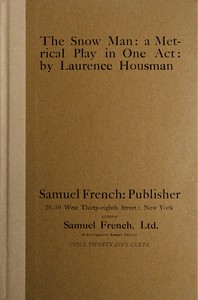
The snow man — Edition Insights
27
14
Project Gutenberg
2023
One-act plays; English drama -- 20th century
Readers of public-domain and historical texts
Project Gutenberg digital edition
en
Edition facts
Words: 9,078
Reading time: 40 min
Text sections: 5
Source:
Project Gutenberg record #70285
Laurence Housman's one-act metrical play uses a single winter evening in a peasant dwelling to contrast the mother's weary labor with children's snow-play, building tension through repeated imagery of cold, warmth, and the boundary between inside and outside.
Editorial Edition Score
4.6/5
★★★★★
★★★★★
Calculated from edition completeness, EPUB availability, text structure and catalogue metadata. Not a user rating.
Edition quality
Laurence Housman's The Snow Man is a one-act metrical play that compresses its action into a single winter evening. The stage directions describe a poor peasant dwelling with precise, almost tactile detail: a low room with a deep hooded fireplace, a bread oven, a cubby-bed, and walls of blue plaster marked by mildew. Outside, the world is white with snow. The play opens with a peasant woman moving with 'quick dogged pace'—a phrase that immediately establishes her relentless labor. She takes black bread from the oven, presses garments, warms milk, and hangs nightclothes by the hearth, never going empty-handed. Against this backdrop of domestic routine, children's voices are heard outside, laughing and shouting, and they begin to sing about a snowman. The structure thus sets up a clear spatial and emotional contrast: the warm, cramped interior of work versus the cold, playful exterior of imagination.
A Stage Built on Contrasts
The play's setting is not merely a backdrop but an active element of the drama. Housman's stage directions are unusually detailed, specifying the placement of every object—the tressle-table, the large window-seat, the spinning wheel, the bread pan, the shelf of crockery, and the pots and pans hanging on the ingle wall. The room is 'wide and low,' with a door to the woodshed opposite the fireplace, and a long low window to the left. This layout creates a series of thresholds: between inside and outside, warmth and cold, work and play. The mother's movements are choreographed to 'economize her time,' crossing the room with purpose. Meanwhile, the children's voices drift in from outside, their song about the snowman a counterpoint to her silent industry. The play's structure hinges on these repeated crossings—physical and auditory—that keep the two worlds in tension.
The Rhythm of Repetition
Housman uses repetition to underscore the mother's labor and the children's play. The stage directions note that she moves 'to and fro' with 'quick dogged pace,' and the children's voices are heard 'laughing and shouting' as they 'occasionally pass the window.' This pattern recurs: the mother's steady, weary circuit of the room is interrupted by bursts of childlike energy from outside. The children's song, 'Here we have a snowman, a snowman,' is a simple, repetitive chant that contrasts with the mother's silent, efficient motions. The play's metrical form—described as 'a metrical play'—likely reinforces this rhythmic opposition, though the excerpts provide only the opening lines. The effect is a kind of musical counterpoint, where the domestic drone is punctuated by the bright, fleeting notes of childhood.
Objects as Markers of Time and Care
The props in The Snow Man are not decorative but functional, each tied to the mother's labor. She takes down garments from before the fire, presses them with a heavy iron, and puts them away in a chest. She puts milk to warm on the fire and gets down two small mugs from a shelf. She fetches night garments from the cubby-bed and hangs them to warm over the bench. These actions are described with a precision that suggests ritual: the mother's work is a cycle of warming, pressing, storing, and preparing. The objects—bread, milk, clothing, fire—are all associated with bodily warmth and sustenance, in direct opposition to the cold outside. The snowman, by contrast, is never seen on stage; it exists only in the children's voices and the audience's imagination. This absence makes it a symbol of everything the interior lacks: freedom, play, and the ephemeral beauty of winter.
The Unseen Snowman as Dramatic Focus
Despite the title, the snowman itself never appears. It is conjured entirely through the children's song and the mother's reactions (which are not detailed in the excerpts). This offstage presence is a deliberate structural choice: the snowman becomes a kind of ghost, a figure of pure imagination that haunts the domestic space. The play's one-act format means that the entire drama unfolds in real time, with no scene breaks. The audience watches the mother work while hearing the children's voices, and the snowman grows in significance precisely because it is never shown. This technique creates a sense of longing and anticipation. The play's title, then, is ironic: the snowman is the central figure, yet it remains invisible, a product of language and song rather than stagecraft. Housman uses this absence to explore the boundary between the real and the imagined, the mundane and the magical.
Readers approaching The Snow Man should attend to the interplay of sound and silence. The children's voices and the mother's movements form a duet that drives the play forward. The detailed stage directions are not mere instructions but part of the text's meaning, creating a world where every object carries weight. Because the excerpts are incomplete, the play's resolution remains unknown, but the structure suggests that the snowman's presence—or absence—will force a reckoning between the mother's world of work and the children's world of play. This is a play best read with attention to rhythm and space, letting the contrasts build.
Reader reflection
How did this book work for you?
Your answers remain private and are stored only in this browser.
Your progress
0
/
10
2
What was your overall reaction to the book?
3
Is this a title you would suggest to others?
4
How demanding did the text feel?
5
Did it raise ideas you would like to talk about?
6
Did the book deliver what you hoped for?
7
How strongly did the book affect you emotionally?
8
Did anything about the book feel genuinely new?
9
In one sentence, what did you learn?
10