1

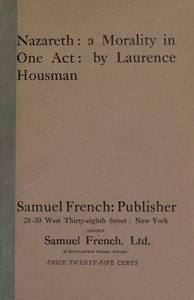
Nazareth: a morality in one act — Themes and Context
27
11
Project Gutenberg
2022
Jesus Christ -- Drama; Mysteries and miracle-plays
Readers of public-domain and historical texts
Project Gutenberg digital edition
en
Edition facts
Words: 8,279
Reading time: 36 min
Text sections: 4
Source:
Project Gutenberg record #69644
Laurence Housman's one-act morality play imagines Jesus' hidden years in Nazareth, using a carpenter's shop setting and prologue to frame the unknown life between childhood and ministry.
Editorial Edition Score
4.5/5
★★★★★
★★★★★
Calculated from edition completeness, EPUB availability, text structure and catalogue metadata. Not a user rating.
Edition quality
The prologue of Laurence Housman's Nazareth: a Morality in One Act immediately acknowledges a gap: the Gospels record little of Jesus' life between his childhood and the start of his ministry. Housman's verse prologue calls this period 'the days which mounted up to Calvary' and admits that the play is not a historical reconstruction but 'a thought, a fathering wish, a prayer.' The scene is set in a carpenter's shop, described as a 'low, broad chamber built of wood,' with a doorway revealing a landscape still pale with heat. This specific, humble setting grounds the play in the ordinary world of Nazareth, inviting readers to consider the human texture of a life largely undocumented.
The Prologue as a Framing Device
The prologue is essential to understanding the play's approach. Housman writes that 'time like a curtain lies' between the reader and Jesus' early life. He emphasizes that Jesus 'waked, slept, ate bread, and toiled,' experiencing human needs 'without speed.' This framing does not claim historical accuracy; instead, it presents the play as an imaginative meditation. The prologue ends with a direct address: 'make your home with Him at Nazareth.' This invitation sets the tone for a work that is more devotional than dramatic, more reflective than narrative.
The Carpenter's Shop as a Theatrical Space
The stage directions describe the carpenter's shop as a 'low, broad chamber built of wood,' with a wide open doorway at the back left-center. The time is 'late afternoon,' and the air is 'still pale with the heat of day.' This specific visual detail—the heat, the wooden chamber, the open door—creates a sense of place that is both ordinary and symbolic. The shop is a workspace, but also a threshold between interior and exterior, private and public. Housman uses this setting to suggest the hidden, daily labor of Jesus' early manhood, a period the prologue calls 'the fair things He did' that are now 'hidden.' The physical space becomes a metaphor for the unknown years.
Language and Rhythm in the Prologue
The prologue is written in rhymed couplets, with a formal, almost liturgical rhythm. Lines such as 'Since Love first looked on life with human eyes' establish a poetic register that contrasts with the plainness of the shop setting. Housman uses repetition and parallel structure: 'Waked, slept, ate bread, and toiled' and 'From mother tongue was taught man's speech to know.' This language emphasizes the ordinariness of Jesus' human experience while elevating it through verse. The prologue also introduces the idea that Jesus 'made humanity His Sacrament,' a theological claim that frames the entire play. Readers should attend to how this poetic voice shapes the moral argument.
What the Excerpts Reveal and Conceal
The available excerpts include the full prologue and the opening stage direction, but the play's dialogue and action are not included. Based on this evidence, the play appears to be a one-act morality with minimal plot, focused on atmosphere and reflection. The prologue explicitly states that the play is not a representation of Jesus himself: 'this simple showing that ye see / Of Love at Nazareth, this is not He!' This disclaimer is crucial: Housman is not attempting to dramatize the life of Jesus but to create a space for contemplation. The catalog classifies the work as 'Adventure & Picaresque Fiction,' which seems at odds with its religious subject matter; readers may find that the play's genre is better described as poetic drama or devotional literature.
Because the excerpts do not include the play's dialogue, readers should approach Nazareth with an openness to its lyrical and meditative qualities. The prologue and setting establish a tone of reverence and humility, inviting the audience to imagine what is not recorded. Housman's disclaimer—that the play is not the historical Jesus but a 'thought'—encourages a reading that is both critical and empathetic. Pay attention to how the language of the prologue prepares you for the action that follows, and consider how the carpenter's shop functions as both a literal and symbolic space.
Reader reflection
How will you remember this book?
Save your reaction, strongest insight, and memorable passage.
Your progress
0
/
10
2
Did this book hold your interest?
3
Is this a title you would suggest to others?
4
How demanding did the text feel?
5
Did you relate to its people, ideas, or situations?
6
Did you gain anything practical from the text?
7
How original did the book feel?
8
Could you see yourself revisiting this book?
9
What changed or sharpened your thinking?
10