1

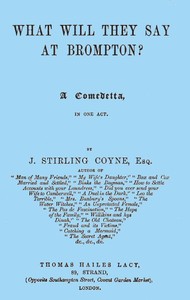
What will they say at Brompton? A Comedetta, in One Act. — A Closer Reading
19
9
Project Gutenberg
2018
Comedy plays; English drama -- 19th century
Readers of public-domain and historical texts
Project Gutenberg digital edition
en
Edition facts
Words: 12,101
Reading time: 53 min
Text sections: 2
Source:
Project Gutenberg record #58114
A one-act comedetta by J. Stirling Coyne, first performed in 1857, using a dual-role structure where Mr. Todd transforms into Signor Toddini, shifting between Brompton domesticity and Italian brigand scenes.
Editorial Edition Score
4.4/5
★★★★★
★★★★★
Calculated from edition completeness, EPUB availability, text structure and catalogue metadata. Not a user rating.
Edition quality
The play opens in Cozy Cottage, Brompton, with Mrs. Todd and the maid Perks packing for a journey. The stage is cluttered with a travelling case, carpet bag, hat case, bandboxes, boots, fishing rod, telescope, and umbrellas—an inventory that immediately signals disorder and imminent departure. This domestic chaos contrasts sharply with the later Italian setting, where the same actor (Mr. F. Robson) plays both Mr. Samuel Todd and Signor Toddini, a dual role that drives the comedy. The title question, repeated by Todd when he imagines what Brompton would say of his adventures, anchors the play's concern with reputation and the gap between mundane suburban life and romanticized foreign escapades.
Dual Roles and Stagecraft
The play's structure hinges on a single actor playing two characters: Mr. Samuel Todd of Brompton and Signor Toddini, an Italian traveller. The cast list explicitly divides characters into “AT HOME” and “ABROAD,” with Todd and Toddini listed under the same actor. This doubling creates immediate visual comedy when Todd, having been kidnapped by brigands, must pretend to be Toddini to avoid detection. The audience sees the same face in different costumes—Todd’s first dress is a large morning gown and black trousers; Toddini wears a foreign cut black coat and white Italian hat. The transformation is not just costume but also manner: Todd’s cowardly, fussy speech shifts to Toddini’s bravado. The stage directions reinforce this by having Todd “transfixed with terror” when confronted by the brigand Jacopo, while Toddini must bluff his way out. The physical comedy of the same actor switching between terrified and swaggering is central to the farce.
Recurring Images of Food and Consumption
Food appears repeatedly as a marker of comfort, danger, and deception. In the opening scene, Mrs. Todd packs a pink satin dress while Perks suggests squeezing master’s boots between a lace cap and an Indian shawl—a comic juxtaposition of domestic order and travel chaos. Later, Todd is lured by Marietta’s promise of supper, and the stage direction notes a tureen of stew. Todd eats greedily, praising the stew’s flavor and comparing it to his late wife’s giblet pie. The food becomes a trap: while he eats, Jacopo replaces Marietta at the table, and Todd’s terror is punctuated by his continued eating. The stew is described as “savory” with tomatoes and mushrooms, grounding the exotic Italian setting in a tangible, comic detail. Todd’s appetite is linked to his gullibility; he drinks wine only after seeing Jacopo drink first, suspecting poison. The recurring motif of eating underscores Todd’s vulnerability and the play’s reliance on physical humor.
Movement Between Domestic and Exotic Spaces
The play’s two scenes—a parlour in Brompton and a brigand’s retreat in Italy—are linked by the journey motif. The opening stage direction emphasizes disorder: a large leather travelling case, carpet bag, hat case, bandboxes, boots, fishing rod, telescope, and umbrellas are scattered about. This clutter signals preparation for travel, but the actual transition is abrupt: Todd is kidnapped and transported to a “picturesque but dilapidated mansion” in Italy. The shift is marked by costume changes and the introduction of brigand characters. The stage directions indicate that Mrs. Todd retires and closes a door, then re-appears, suggesting the same actress plays both Mrs. Todd and Marietta. This doubling further blurs the line between home and abroad. Todd’s exclamation, “What would they say at Brompton if they could see me?” directly contrasts the domestic audience (Brompton) with his current predicament, highlighting the play’s central joke: the mundane suburbanite thrust into melodramatic adventure.
Voice and Dialogue Patterns
The dialogue relies on rapid exchanges and asides that reveal character. Todd’s speech is peppered with exclamations and self-conscious remarks: “Todd, you are a dead mackarel!” and “Private and confidential assassination!” His asides to the audience create intimacy and underscore his cowardice. In contrast, Jacopo speaks in short, commanding sentences: “Proceed with your compliment, signor.” and “Sit down!” The repetition of the title phrase “What will they say at Brompton?” serves as a refrain, anchoring Todd’s anxiety about social reputation. The play also uses malapropisms and exaggerated politeness, as when Todd says, “I’ll do myself the honour of drinking your health” while fearing poison. The dialogue’s rhythm—staccato commands from the brigands, flustered responses from Todd—drives the farcical pace. The asides, such as Todd’s “Hah! I begin to feel I’m a lonely cockle on life’s dull shore,” mix bathos with self-pity, enhancing the comic effect.
This comedetta rewards attention to its physical staging and the actor’s dual role. The clutter of the opening scene, the repeated food imagery, and the abrupt shift from Brompton to Italy all serve the farce. Coyne’s play is best enjoyed as a performance piece, where the visual gags and rapid dialogue create a tightly wound comic mechanism. Readers might imagine the stage business—the spoon frozen mid-air, the terrified glance—to fully appreciate the humour.
Reader reflection
How did this book work for you?
Your answers remain private and are stored only in this browser.
Your progress
0
/
10
2
Did this book hold your interest?
3
Is this a title you would suggest to others?
4
How much effort did this book require?
5
Did the book offer a fresh perspective?
6
How well did it match your expectations?
7
Could you follow the author’s main argument?
8
What was the strongest part of the book?
9
What is the main idea you are taking away?
10